Motion offense uses rules for spacing, passing, cutting and screening. Players make decisions within the version their coach teaches. Princeton combines those decisions with named entries and continuations. This page compares several motion alignments and shows how to teach them in layers.
Motion offense is the foundation under the Princeton system and under dozens of offenses run at every level. Done right, it is one of the hardest offenses to scout because the decisions live with the players, not with a play caller. Done wrong, it is five players jogging in circles.
Define the rules for the motion version you teach. The following are practical starting points.
Watch first: a two-guard front running motion reads and second-side action. Full breakdown on the Michigan 2-guard series video page.
What Is Motion Offense?
Motion offense is a player-movement system. Spacing, cutting, passing, and screening follow a short set of rules rather than a memorized sequence. Players read the defense and react. There is no "Play 4." There is positioning, rules, and freedom inside those rules.
A called set specifies an entry and sequence, but it can still contain reads and counters. Motion gives players more choices within its rules. The distinction is how the action starts and continues, not whether players use their judgment.
One thing to keep straight, because coaches mix these up:
- A system is a whole offense with a philosophy. Motion, Princeton, dribble drive, flex.
- An action is a reusable piece. A ball screen, a backdoor cut, a dribble handoff.
- A set is a called play. A quick hitter, a baseline out of bounds play.
A team runs a system, calls sets out of it, and builds both from actions. Motion is a system. When someone calls a backdoor cut "the Princeton offense," they are naming an action, not the system.
Five Useful Motion Teaching Points
Motion systems differ in their spacing and post rules. Use these teaching points as a starting framework, then follow the rules of the version you install.
1. Space the floor at 15 to 18 feet. Wide enough that one defender cannot guard two players. Tight enough that the kick-out pass is still catchable. Spacing is the rule the other four depend on. If it collapses, nothing else works. Bob Huggins teaches 15 to 17 feet. The number matters because it gives you something to correct on the floor instead of yelling "spread out."
2. Give the passer a next job. That can be a basket cut, a screen, a relocation or holding useful spacing. Lee’s “stand judiciously” cue distinguishes occupying a defender from watching the ball without a purpose.
3. Let the defender tell you which cut. If your defender sags, cut hard to the basket for the give and go. If your defender overplays or denies, go backdoor. If a teammate dribbles at you, go. Pete Carril's version is the simplest: when closely guarded, go backdoor. Watch the person in front of you. They show you what to do.
4. Catch ready to shoot, and look at the rim first. The most open a player will ever be is the instant the ball arrives. Catch on balance, eyes on the rim, then decide. Fake before you move. The shot fake, the pass fake, the fake cut. A defender who has to honor the fake is already a half step late.
5. Connect the pass to the next action. Moving the ball makes the defense adjust. A purposeful cut, screen or relocation gives the passer a next option. A player may hold space when moving would crowd the action.
Two Cues I Use Instead of Twenty
Two cues from my player notebook explain how to move with purpose and how to hold useful space.
Cut credibly. Look for the ball as you come open, then get back outside quickly. A cut that does not expect the ball is a jog. The defense knows the difference.
Stand judiciously. Float to the open spot and occupy your man. Ball in the air, feet in the air. Standing is allowed only when it holds a defender who would otherwise help.
Two more from my notebook that shape everything above. This offense is more about cutting than screening. Move to open spaces, screen, and read. And hit the cutter with a bounce pass. Timing and cutting, not screening, set the flow.
The Four Motion Alignments, Compared
The right motion offense depends on how many players you want inside. Each alignment below runs the same pass, cut, and read rules from a different starting picture. Pick the one that fits your roster, not the one you saw on television.
| Alignment | Inside players | Best for | The catch |
|---|---|---|---|
| 5-Out Motion | None | Teams that want an open-post starting picture and shared perimeter decisions. Shooting can stretch help, while cutting and screening give non-shooters useful jobs. | A defender who sags can reduce driving space. Give that offensive player useful cutting, screening or passing work, and assign rebounding and transition roles. |
| 4-Out 1-In Motion | One | The most common alignment. One post for duck-ins and ball screens, four perimeter players for cuts and drives. | The post has to move with the ball or he clogs the lane the cutters need. |
| 3-Out 2-In Motion | Two | Teams with two capable bigs and fewer shooters. High-low passing and post screens. | Spacing is tightest. Weak perimeter shooting lets the defense pack the paint. |
| Circle Motion | None | Youth and beginner teams. Pass, cut, rotate. Equal touches and constant movement. | Predictable once a team can scout it. A bridge, not a destination. |
Choose the alignment for your roster and teaching goal. Three-out, four-out and five-out are alternatives. A youth team can start with five-out pass-cut-fill, and an experienced team can still feature two posts.
The Three Entries: Pass and Cut, Dribble At, and the Reset
Motion needs a way to start and a way to restart. These three cover it.
Pass and cut. The player with the ball passes to a teammate, takes two hard steps toward the ball, and reads. If the defender is soft, cut to the basket. If the defender denies, break backdoor immediately. Then fill the open spot on the weak side so the spacing rebuilds.
Dribble at. Agree on the cue before installing it. Some versions use a backcut. Others use a handoff when open and a backcut when denied. Lee’s breakdown drills include both options. The two players must use the same rule.
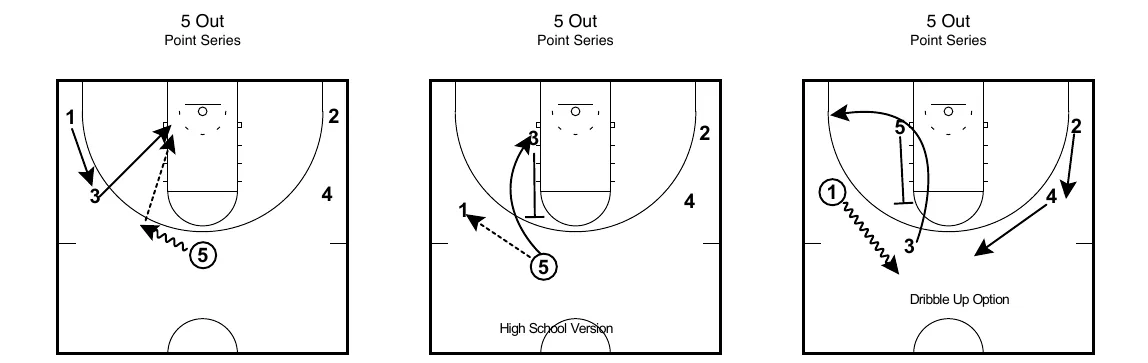
The reset. Every motion offense needs an answer for the possession that stalls. In the Princeton system the answer is a dribble up to the guard spot, which puts the team back in the Chin Set. Whatever your reset is, it has to be a rule the players run without looking at the bench.
Screening in Motion Offense
Screens are a tool in motion, not the point of it. They come out of the flow rather than a diagram.
- Back screen. Set for a cutter coming from the perimeter toward the basket.
- Down screen. Set for a player coming from the block up to the perimeter.
- Flare screen. Set on the weak side to free a shooter drifting away from the ball.
- Flex screen. A baseline screen the cutter uses along the baseline.
Three jobs, three techniques. The cutter runs his man into the screen and changes speed. The passer delivers on time and never loses his dribble. The screener finds the defender, sets a solid screen, and then becomes dangerous. The screener who sets a good screen gets rewarded, because his man helps and he comes open on the slip.
One rule that saves a lot of collisions: the screener may slip any time, unless the cutter is curling or going backdoor.
How to Install Motion in Four Steps
Motion fails when a coach gives players every option on day one. Teach one layer at a time. Do not add the next until players can explain the trigger behind the current one.
- Spacing and pass-cut-fill, 5 on 0. Five spots, 15 to 18 feet. Pass, cut to the basket, fill the open spot. No dribble. Freeze the drill any time one defender could guard two players.
- Add the denial read, 2 on 2 and 3 on 3. Tell the defense to deny once and sag once. The cutter has to pick the right answer. The passer has to deliver on time.
- Add screens, 4 on 4. Pass and screen away. Teach the three jobs. Drill the slip after every screen so screeners learn a good screen earns them the ball.
- No-dribble 5 on 5. Željko Obradović ran a no-dribble passing game every practice to force movement without the ball. It is the fastest way to find out who stands.
One more rule from my own install: choose one option and get your players to execute that option before you give them a choice. Read-based offense dies when you layer options before the first one is automatic.
The 10-practice install plan lays this out practice by practice for the Princeton version. The cutting drills page covers step one and two in detail.
Where Princeton Fits
Lee’s Princeton offense combines named entries with defensive reads. Chin, Five Out, Low, Point, Twirl and X have different starting actions and connections. The playbook also has quick hitters. Preserve each set’s timing instead of applying one universal pass-cut rule.
If you like motion but your players need more scaffolding, that is the direction to look. Start with Princeton offense vs motion offense for the side-by-side, then the Princeton Offense rules.
Motion Offense Decision Table
| Coaching question | Motion answer | Princeton connection |
|---|---|---|
| How do we punish denial? | Backdoor cut the instant the defender takes away the passing lane. | Princeton backdoor cuts turn that read into a repeatable scoring rule. |
| How do we avoid random movement? | Limit players to pass-cut-fill, screen away, and dribble at until the habits are automatic. | Princeton gives every movement a trigger. |
| How do we teach counters? | Train what happens when defenders switch, trail, deny, or sag. | Princeton counters organize those answers by coverage. |
| What happens when it stalls? | A reset rule the players run on their own. | Dribble up to the guard spot, back into Chin. |
Common Motion Offense Mistakes
- Too much freedom too early. Young teams need two or three rules before they can handle full read-and-react freedom.
- Movement without purpose. Cutting just to move clogs the lane and steals the ball handler's spacing.
- No pressure-release rule. Every motion offense needs a built-in answer when the wing is denied.
- Filling too early. When a teammate drives, the next player fills the spot before the driver has used it. The lane closes. Hold the double gap.
- Weak teaching language. Players improve faster when each read has a name, a cue, and a correction.
Motion Offense FAQ
Is motion offense the same as Princeton offense?
No. Princeton is a structured motion offense with named entries, a high post read, backdoor rules, and a reset. Plain motion has the rules without the named structure.
What is the first motion rule to teach?
Spacing at 15 to 18 feet, then pass-cut-fill. Without spacing every other rule breaks down.
Can high school teams run motion offense?
Yes, if the install is layered. Two or three rules first, then reads, then screens. Teams that get every option on day one usually end up standing.
Which motion alignment should a youth team use?
Choose an alignment that gives these players usable passing angles and clear jobs. Five-out pass-cut-fill is one teaching option. Four-out can feature a post, while three-out can feature two. The choice does not depend only on age or three-point shooting.
How long does motion offense take to install?
The base rhythm of spacing and pass-cut-fill can be running in a few practices. Reads and screens take longer. The 10-practice plan is a realistic pace for the Princeton version.
Next Step for Coaches
If you want motion with more structure, compare Princeton offense vs motion offense. If you are ready to install a read-based system, start with the Princeton Offense rules and the 10-practice install plan. For a close cousin, see the passing game offense.
Take Your Offense to the Next Level
The Princeton package includes the playbook with six sets, original diagrams, set plays and counters, plus the video walkthrough and Practice Plans & Drills Guide.
Get the Playbook, $39 →