3-Out 2-In Motion Offense: Coaching the Two-Post System
9 min read
If you are lucky enough to have two good post players, you should not spread them to the perimeter and waste them. The 3-out 2-in motion offense is built for exactly this team: three players on the perimeter, two players inside, and an offense that scores through high-low passing, inside-out reads, and relentless post screening. It is power basketball with motion principles underneath it.
Watch first: the post-up moves a two-post alignment is built to feed. Notes on the post-up moves video page.
What Is the 3-Out 2-In Motion Offense?
The alignment is three out, two in: a point guard and two wings on the perimeter, with two posts inside. Unlike a rigid set, it is a motion offense, the players read the defense and react within a structure rather than running scripted plays. The two posts give you interior scoring, offensive rebounding, and a constant high-low threat that pulls the defense apart.
Alignment and the Spacing Challenge
The hardest part of any two-post offense is spacing. Two bigs standing next to each other invite one defender to guard both and turn the lane into a crowd. The fix is a non-negotiable rule:
The Perimeter Rules
The perimeter players pass, cut, fill and read the post. With two inside players, identify which lane is open before driving. Teach the posts to react to the direction of penetration:
- The post in the driving lane clears it. For example, on a baseline drive the ball-side post can lift toward the elbow.
- The opposite post finds a dump-off window without bringing a second defender into the driver.
- The other guards relocate behind the drive for a swing pass and a clean look.
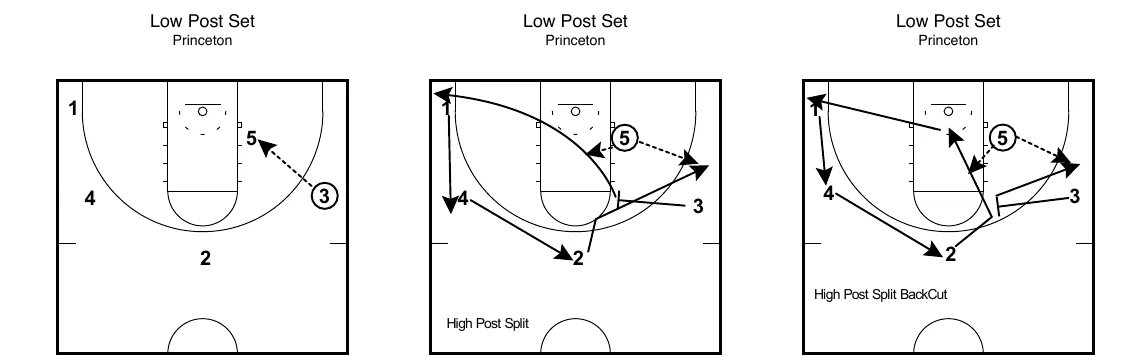
The Post Actions
Rules for the Two Inside Players
Two posts clog the lane when nobody has told them what their job is. The clearest set of inside-player rules I know comes from Aito García Reneses, the Spanish coach who taught a structured 3-out 2-in motion for decades. Three rules, in his words more or less.
- Do not demand the ball unless your defender has helped and there is a clear path to the basket.
- Help your teammates. Set screens, clear out when a guard drives baseline, and go after offensive rebounds. Inside players are coached to help, not to call for the ball.
- Move when the help moves. The inside players adjust their positions to make themselves available after a teammate draws help. Teach the exact exchange, screen or clear-out for your version so both posts do not end up in the same space.
Aito's perimeter rules are just as short. Keep at least four meters, about 13 feet, between outside players at all times. Dribble only to penetrate, and if you are not penetrating, use at most two dribbles to improve a passing angle. When a kick-out or a cut finds you and your defender is sagging, shoot. Do not drive from a spot where the defense has already given you the shot.
And the rule that fixes most stalled two-post offenses: after you pass into the post, move. Go to the point, go to the corner, or cut to the basket. A passer who stands lets his defender dig on the post and recover for free.
The High-Low Read That Makes Two Posts Worth It
The reason to keep a second big on the floor is the high-low pass. One post at the elbow, one on the block, on the same side, with a direct line between the ball and the basket. That line is the whole read. If the low post is not in a direct line with the ball and the rim, he is easy to defend, because his man can split both threats at once.
Once the line is set, the low post's defender has to choose. Front, behind, or side. Each choice opens a different pass. Fronted, throw the lob toward the corner of the backboard and let the post catch it above his head. Played behind, bounce pass after the seal. The post waits for the bounce, grabs it with two hands, then pivots to score. The defender tells the high post what to throw. That is what makes the read teachable.
One spacing rule keeps it alive without a call: when a guard dribbles to the wing to get a better angle to the post, the corner player sprints to the top. This structure is built for posts who score but do not shoot from the perimeter, which is exactly the roster that should be in 3-out 2-in in the first place.
Why 3-Out Can Be Easier to Drive Than 4-Out
Coaches assume more spacing always means better driving. Vance Walberg, who built the dribble drive out of a four-out picture, noted the opposite in some situations: three out is easier for dribble penetration than four out. The wider spacing sometimes puts the kick-out man too far away for the driver to time the pass. Three out creates a tighter driving geometry. If your guards drive well and your bigs finish, 3-out 2-in is not a compromise. It is a choice.
Why It Works
- It maximizes two bigs. Instead of hiding a post in a corner, both are involved on every possession.
- It owns the offensive glass. Two players near the rim means second-chance points all night.
- High-low is efficient. Feeding over the top of a sealed defender produces layups and free throws.
- It punishes help defense. Help on a post leaves the other post or a shooter open inside-out.
Coaching Points
- Posts must move. A stationary post is a clogged lane. Duck in, flash, screen, never just stand.
- Feed with angles. Guards step to create a passing angle into the post. A flat feed gets deflected.
- Guard the spacing. The three perimeter players must stay wide. If the guards collapse, there is nowhere to kick the ball. (See spacing in basketball offense.)
Two bigs is a gift, but only if they move. Park them and you have a parking lot in the lane. Keep one high and one low, screen for each other, and let the guards drive into the mess, now two bigs is a weapon.
, Coach Lee DeForest
3-Out 2-In vs. Other Motion Alignments
If your two posts cannot both stay involved, or your guards need more room to drive, consider dropping to the 4-out 1-in motion offense and pulling one post to the perimeter. If you want pure spacing with no post, the 5-out motion offense is the answer. The 3-out 2-in is the right tool specifically when interior size and rebounding are your edge, lean into it, and pair it with the high-low offense reads.
Frequently Asked Questions
What is the 3-out 2-in motion offense?
The 3-out 2-in motion offense uses three perimeter players (a point and two wings) and two post players. It runs on high-low passing, inside-out reads from guard penetration, and post screening actions, making it ideal for teams with two capable bigs.
How do you keep two posts from clogging the lane?
Start with one post high and one low, then teach the exchanges required by your version. The posts must leave room for each other and for penetration. A baseline drive and a middle drive need different post reactions.
When should I run 3-out 2-in?
Run 3-out 2-in when you have two skilled or physical post players you want on the floor together, when you want to dominate the offensive glass, or when your guards are better passers and drivers than shooters. It trades some perimeter spacing for interior power.
What is the difference between 3-out 2-in and 4-out 1-in?
3-out 2-in keeps two posts inside for high-low play and rebounding but has tighter perimeter spacing. 4-out 1-in pulls one post out to the perimeter, opening more driving lanes at the cost of one interior threat. Choose based on how many bigs you want to feature.
How far apart should the three perimeter players be in 3-out 2-in?
Aito García Reneses teaches at least four meters between perimeter players in his version. Treat that as a system cue. Adjust the starting spots to the court and players, and preserve clear passing and driving lanes as the action develops.
What should the passer do after feeding the post?
Move. Go to the point, go to the corner, or cut to the basket. A passer who stands still lets his defender dig on the post and recover with no cost.
Get the Complete Princeton Offense System
The Princeton package includes the playbook with six sets, original diagrams, set plays and counters, plus the video walkthrough and Practice Plans & Drills Guide.
Get the System, $39