4-Out 1-In Motion Offense: The Complete Guide
10 min read
If you have one good post player and four players who can handle and shoot a little, the 4-out 1-in motion offense is probably the best structure you can run. It keeps the floor spread like a 5-out, but it gives you an inside hub, a player who can post up, set ball screens, and screen for cutters. When coaches say they run "4-out motion," this is almost always what they mean.
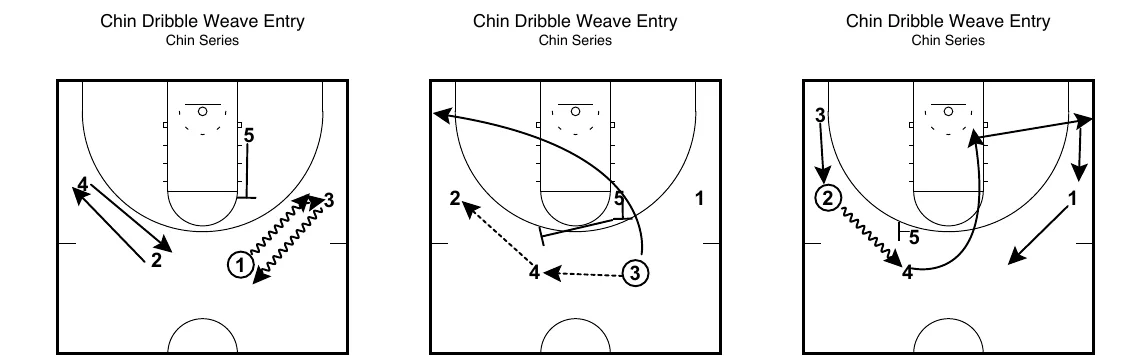
Watch first: the Princeton Chin set video. Lee starts Chin with 5 on the ball-side block. The post moves up for the backscreen and immediate flare after the weave and reversal. That is one specific four-out action.
What Is the 4-Out 1-In Motion Offense?
The name describes the alignment: four players spaced on the perimeter and one player in the post (the "1-in"). The four perimeter players run motion principles, pass and cut, dribble-at, screen away, while the post operates inside as a constant threat and a screening hub. It is a read-based motion offense, so the players react to the defense rather than running a scripted play.
Alignment and Spacing
Set the four perimeter players in two corners and two slots (or two wings and two slots), and place the post on a block or at an elbow. The spacing rule is the same as every motion offense: fifteen to eighteen feet apart. The key adjustment with a post on the floor is that the perimeter players must respect the post's space, nobody drives directly into the post's defender or the help is free.
The Post: High vs. Low
Where your post plays changes the whole feel of the offense:
- Low post. The post sits on the block for direct post-ups, duck-ins when the defense fronts, and offensive rebounding. Best for a strong, back-to-the-basket scorer.
- High post. The post plays at the elbow or free-throw line, opening the entire lane for backdoor cuts and drives, and becoming a passing hub for high-low feeds and dribble handoffs. Best for a skilled, passing big.
The Reads
Post Actions That Make It Hum
The post is not just a target, it is a screener and a connector. The best 4-out 1-in teams use the post to:
- Duck in across the lane when the defense turns its head, sealing for a quick interior catch.
- Set ball screens for the point, turning the motion into a pick-and-roll on demand. If you want to go deeper, see the pick and roll offense breakdown.
- Screen for cutters, a back screen for a slot drive, or a flare screen for a shooter.
- Flash high to receive and feed cutters going backdoor, the same high-post action that anchors the Princeton offense.
Three Ways Good Coaches Use the One Post
The alignment is the same. What the post does is what separates the systems built on it. Pick one job for your post and teach it until it is automatic before you borrow from the others.
The post as the screener. In the blocker-mover offense, the single post is the primary blocker and the four perimeter players are movers who cut and relocate. The post sets down screens and back screens all possession. Simple roles, less decision fatigue, a good fit for young teams that cannot yet handle free reads.
The post out of the way. In the dribble drive motion, the post lives on the weak side and the middle of the floor stays empty on purpose. The four perimeter players attack the rim off the dribble and hunt layups, fouls, and kick-out threes. The post's job is to stay out of the driver's lane until the drive commits help, then finish.
The post as the passer. Lee uses the high-post catch in Point and the low-post catch in Low. Chin starts with the post on the ball-side block and uses a backscreen followed immediately by a flare. Keep those entries and post jobs distinct.
The Two-Passes Rule
A two-pass requirement can be a temporary practice constraint to encourage ball movement. It is not a universal motion rule or a reason to pass up an open layup. Define a good shot for each player and teach the group to take an available advantage.
When to Move Up or Down an Alignment
Choose an alignment for the players and actions you want to teach. Three-out, four-out and five-out are different spacing choices, not compulsory stages of development. A young team can learn five-out pass-cut-fill while its shooting develops. A skilled older team can still use two posts.
Why It Works
The 4-out 1-in motion offense gives you the best of both worlds: the spacing and driving lanes of a spread offense, plus an interior hub that defenses have to account for. It is flexible enough to feature a dominant post or simply use an average post as a screener and connector. And like all motion, it teaches reads, not memorized plays.
One good post changes everything. In 4-out 1-in you do not need that post to score twenty, you need them to seal, screen, and pass. Do that, and the four players around them get layups and open threes all night.
, Coach Lee DeForest
4-Out 1-In vs. 5-Out
The choice comes down to your roster. With no true center, the 5-out motion offense empties the paint and maximizes driving lanes. With one strong interior player, 4-out 1-in keeps that spacing but adds a post hub. If you have two bigs, step up to the 3-out 2-in motion offense. The principles, spacing, cutting, reading the defense, never change. Only the alignment does.
Frequently Asked Questions
What is the 4-out 1-in motion offense?
The 4-out 1-in motion offense spaces four players around the perimeter and one player in the post. The perimeter runs pass-and-cut and dribble-at reads while the post serves as a hub for duck-ins, ball screens, post-ups, and screening actions for cutters.
Is the 4-out motion offense the same as 4-out 1-in?
In practice, yes. When coaches say 4-out motion offense they almost always mean four players on the perimeter and one in the post, the 1-in. A true four-out with a completely empty post is rare. The post player is what makes the offense a 4-out 1-in.
When should I use 4-out 1-in instead of 5-out?
Use 4-out 1-in when you have one strong post player you want to feature inside while keeping good perimeter spacing. Use 5-out when you have no true center and want to maximize driving lanes with an open paint.
Where does the post player line up in 4-out 1-in?
The post can play high (at the elbow or free-throw line) or low (on the block). A high post opens the lane for backdoor cuts and dribble penetration. A low post is better for direct post-ups and offensive rebounding. Many teams let the post flash between the two.
What does the post do in a 4-out 1-in motion offense?
It depends on the system. A post may screen, seal, pass or move away from a drive. In Lee’s Princeton system the job changes by set. Chin starts low, Point uses a high-post catch, and Low works through a low-post catch.
What is the first rule to teach in 4-out 1-in?
Teach the starting spots and what happens after a pass. Use a pass-count constraint only when it serves the practice goal. Keep open layups and good shots within a player’s range available in live play.
Get the Complete Princeton Offense System
The Princeton package includes the playbook with six sets, original diagrams, set plays and counters, plus the video walkthrough and Practice Plans & Drills Guide.
Get the System, $39