5-Out Motion Offense: The Complete Coaching Guide
10 min read
Five-out motion is one option for teaching spacing, passing and cutting from an open-post alignment. Compare its rules with the players you have and the system you intend to teach. Lee’s named Princeton Five Out has its own entry and continuations.
Watch first: spacing, cutting, and the backdoor read, the base every 5-out runs on. Full notes on the coaches clinic video page.
What Is the 5-Out Motion Offense?
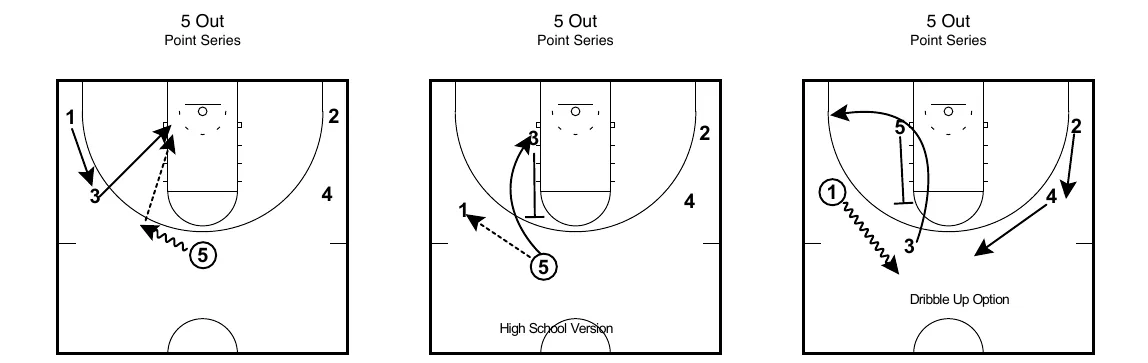
Five-out describes an alignment with all five players outside at the start of an action. The offense can use pass-cut-fill, screens, handoffs or more specific entries. An open-post alignment creates room only if players preserve the spacing and read the defenders.
The Five Spots and Spacing
Start in a basic five-out alignment: two players in the corners, two on the wings (or slots), and one up top. That is five spots evenly spaced around the arc. The single most important rule in the entire offense is the one coaches break the most:
The Three Core Rules
The entire 5-out motion offense runs on three actions. Teach these three and your players can run it from anywhere on the floor.
Layer in one more habit and the offense comes alive: drive and kick. When the open lane appears, attack it. If help steps over, kick to the open shooter and let the ball move. Penetration plus good spacing is the engine of every motion offense.
Reading the Defense: The Backdoor Is Always There
The 5-out motion offense punishes aggressive defense. If your defender overplays the passing lane to deny you the ball, you do not fight for the catch, you cut backdoor for a layup. That single read keeps the defense honest. Once they stop denying, the perimeter passes open up and the cuts and screens do their work. Teach your players to read their own defender, not the ball, on every possession.
Why the 5-Out Motion Offense Works
- It develops every player. Guards and bigs all pass, cut, screen, and finish. There are no specialists standing in a corner.
- Spacing needs attention. Players must fill the appropriate spots and keep cuts, screens and drives from arriving in the same space.
- Rehearse defensive adjustments. A defense can disrupt entries, switch screens or protect the lane. Teach the response that belongs to the chosen motion rules.
- It fits a no-post roster. If you do not have a true center, 5-out turns that into a strength by spreading the floor.
Coaching Points
- Cut hard or do not cut. A jogged cut is useless. Every basket cut is a real sprint that the defense must respect.
- Fill the open spot. When a teammate cuts through, somebody must fill behind to keep all five spots full. Empty spots kill the spacing.
- Catch ready to shoot. Every catch on the perimeter is a triple threat, shoot, drive, or pass, so the closeout has something to fear.
- Pass and move. Standing still after a pass is the cardinal sin. The passer always cuts, screens, or relocates.
Most coaches over-coach offense. Give players great spacing and three honest rules, cut, dribble-at, and screen away, and let them read the game. They will create better shots than any play you could call from the bench.
, Coach Lee DeForest
5-Out Motion vs. the Princeton Five Out
General five-out motion is a family of rule sets. Lee’s Princeton Five Out is a named part of his system with its own entry, reads and connections. Both put five players outside at a point in the possession, but their starting spots and subsequent movement need not match.
The Nine Rules, in Teaching Order
Keith Rumjahn’s Complete Guide to Motion Offense presents the following progression. These are layers within his version. Add one when players can execute the earlier spacing and cuts against defense.
- Spread to the five spots. Top, two wings, two corners. Fifteen to eighteen feet apart.
- Catch ready to attack. Balanced, eyes on the rim, even if you are not a shooter. Fake it until the defense has to respect it. This is the hardest rule and the most important one.
- Pass and basket cut. Every pass is followed by a cut to the rim.
- Always fill the five spots. When a cutter leaves, the next player fills. Spacing rebuilds itself.
- If denied, back cut. The overplay is the trigger. No juking, no V-cut to get open. Back cut and fill from behind, or down screen and fill.
- Pass and screen away. Once cutting is established, add screening away as another choice. The cutter reads the defender. The screener fills or cuts into the space the cutter leaves.
- Pass and screen on the ball. The last screening layer.
- If dribbled at, read the handoff. In this version, take the handoff when open. Backcut when the defense jumps the exchange.
- Post-ups must be quick. A long post-up kills the spacing that makes everything else work.
Hackenberg’s screen-away version limits the dribble to attacking the rim, improving a passing angle, or relieving a count where that rule applies. Keep that attribution clear. His rule set and Rumjahn’s progression are related examples, not one combined system.
The Two Costs of Going 5-Out
The spacing is the strength and the weakness. Two things break if you do not plan for them.
Offensive rebounding. Starting outside means players need clear responsibilities when a shot goes up. Assign who attacks the glass and who protects against transition. The number depends on the shot, personnel and opponent.
A defender who sags. A non-shooter’s defender can stay near the lane. Give that player useful work as a cutter, screener or passer. Five-out is a starting alignment, not a requirement that every player shoot threes.
How to Teach It in Practice
Install it in layers. Begin with pass, cut and fill. Add a guided defender so players learn the denial read. Then introduce the handoff or screening rule you have chosen, and put the actions into five-on-five. Advance when players can recognize the cue and preserve spacing under pressure.
Frequently Asked Questions
What is the 5-out motion offense?
Five-out motion begins with five players outside and an open post. The coach defines the pass, cut, screen and dribble-at rules for that version. In the progression shown here, a dribble-at can become a handoff or a backcut against denial.
Is the 5-out motion offense good for youth basketball?
Yes. With no post to clog the lane and only a few rules, 5-out is one of the best youth and beginner offenses. It teaches spacing, passing, cutting, and reading the defense, and it gives every player equal involvement.
What is the difference between 5-out motion and 4-out 1-in?
5-out keeps all five players on the perimeter with an open paint, maximizing driving lanes and spacing. 4-out 1-in keeps one player in the post as a hub for duck-ins, ball screens, and high-low actions. Use 5-out when you have no true post. Use 4-out 1-in when you have one strong interior player.
How is 5-out motion different from the Princeton Five Out?
General 5-out motion is rules-based and free-flowing, players react to the defense within a few principles. The Princeton Five Out is a structured set with specific reads and counters built into the Princeton offense. They share spacing, but the Princeton version is more defined.
Why does my 5-out offense stand around after the first pass?
Because the fill rule is missing. When a cutter leaves a spot, the next player has to fill it. Without that, the cutter has nowhere to go and the passer has nobody to pass to. Drill pass, cut, fill 5 on 0 before anything else.
Who rebounds in a 5-out motion offense?
Assign rebounding and transition roles before the shot. Five-out does not prescribe one crasher and four players back. Choose responsibilities that fit your team and the shot location.
Get the Complete Princeton Offense System
The Princeton package includes the playbook with six sets, original diagrams, set plays and counters, plus the video walkthrough and Practice Plans & Drills Guide.
Get the System, $39