Circle Motion Offense: Constant Movement, Equal Touches
8 min read
Here, circle motion means a five-out pass-cut-fill teaching pattern. Other coaches may use the same name differently. Teach the specific rotation below so players know which spot opens after each cut.
Watch first: a map of a full read-based system, which is where circle motion should lead once your players can read a defender. Notes on the blueprint video page.
What Is the Circle Motion Offense?
Here, circle motion describes a five-out continuity. The passer basket-cuts and fills the weak-side corner while the wing and corner behind that cut move up. The ball receiver and ball-side corner keep their spacing. Other coaches may use the name for a different pattern.
How the Rotation Works
In this pass-and-cut version, the passer cuts to the rim and teammates fill the empty spots. Add guided defense so players learn when the cut and return pass are available.
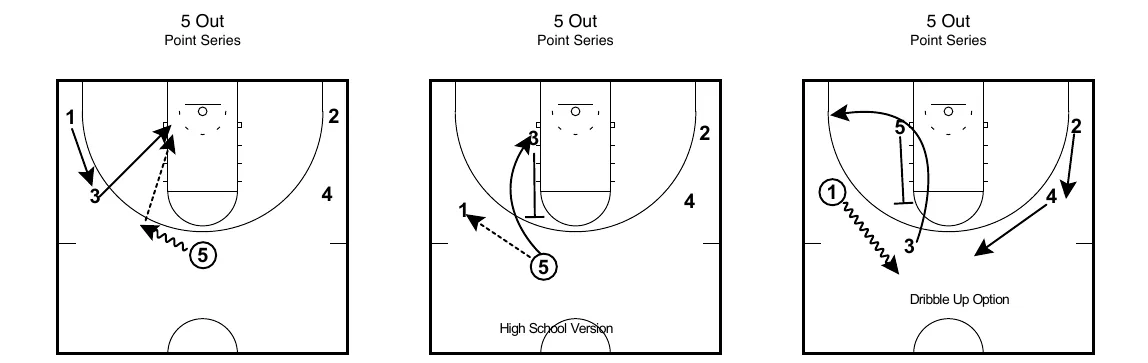
The Reads
Why Coaches Love It (Especially for Youth)
- Equal touches. The ball moves to everyone, so no single player dominates and every kid stays engaged.
- Purposeful movement. The passer cuts and the players behind fill. Other players can hold useful spacing until the next action reaches them.
- It teaches real skills. Cutting, spacing, passing, and reading the defense are baked into the rules.
- Small initial package. Start with pass, cut and fill. Add the defensive reads when players can keep the rotation organized.
Adding Reads as Players Grow
Start with pure pass-and-cut. As your players mature, layer in the backdoor cut against denial, the give-and-go finish, and eventually a dribble-at to send a teammate backdoor. These are the same reads that anchor the 5-out motion offense and the Princeton offense, so circle motion becomes a perfect on-ramp to a more advanced system later.
A Continuity Teaches the Habit. Reads Make It Dangerous.
Circle motion is a continuity, the same family as the flex. A continuity has no endpoint. It keeps recycling until a shot appears, which is exactly why it teaches young players ball movement, cutting, and patience better than a set play that ends and leaves them standing. One-on-one play should come out of that framework at time-and-score moments, not as the panic option when the play runs out.
The cost is the same as every continuity. It is predictable once a team scouts it, and it is vulnerable to switching defenses. The answer is not to abandon it. The answer is a small library of entries and a few reads layered on top, added one at a time.
Three Reads to Add, in Order
- Catch ready to attack. Balanced, eyes on the rim, every catch, even for non-shooters. This is the hardest habit and the most important one. Add it before any other read.
- If denied, back cut. The overplay is the trigger. No V-cut, no juking to get open. Back cut, and the next player fills. This is the read that turns a scoutable circle into layups.
- If dribbled at, go. The ball handler dribbles straight at the next player in the circle. That player leaves, usually backdoor, and the handler takes his spot. No defensive mistake required.
A two-pass rule can be useful for a short practice game that emphasizes movement. Remove it when it makes players ignore an open layup. In live play, judge the shot and the advantage rather than the pass count.
When to Leave Circle Motion
Keep this pattern while it meets the team’s needs. Add reads when players can maintain spacing and recognize denial. A move to four-out or another five-out version is a roster and teaching choice, not a graduation requirement.
Coaching Points
- Cut to score, not to clear. Every cut is a real scoring threat, sprint to the rim, do not jog through.
- Hold the spacing. Fill to the open spot, not toward the ball. Bunched players kill the circle.
- Catch and face. Each catch should be ready to shoot, drive, or pass before continuing the rotation.
For a young team, the circle offense is a gift. You teach three words, pass, cut, fill, and suddenly all five players are moving with a purpose. They are learning real basketball and having fun doing it.
, Coach Lee DeForest
Circle Motion vs. 5-Out Motion
Circle motion is a specific, structured continuity within the broader 5-out motion offense. The circle gives you a predictable, repeating pattern, perfect for teaching, while general 5-out motion gives players freedom to choose between cutting, screening, and dribble-at reads. Many coaches start their team in the circle for the structure, then open it up into full 5-out motion as players learn to read the game. For more simple, teachable offense, see our youth basketball plays and simple basketball plays.
Frequently Asked Questions
What is the circle motion offense?
The circle pattern described here uses five perimeter spots. After a pass, the passer basket-cuts and fills the weak-side corner. The weak-side wing and corner move up to fill the openings. The ball-side corner can hold its space.
Is the circle motion offense good for youth basketball?
Yes, it is one of the best youth offenses. The rules are simple (pass, cut, fill), every player touches the ball, and the constant motion teaches cutting, spacing, and passing without memorizing plays.
What is the difference between circle motion and 5-out motion?
Circle motion is a specific continuity within the 5-out family: after passing, players always cut and rotate the same direction, so the offense loops automatically. General 5-out motion gives players more freedom to choose between cutting, screening, and dribble-at reads.
How many players move in the circle motion offense?
The passer cuts, and the players behind the opening fill in sequence. The receiver handles the ball while other players hold or adjust their spacing. Everyone does not have to rotate on every pass.
What is the weakness of the circle motion offense?
It is predictable once a team scouts it, and switching defenses can take away the rotation. The fix is a few entries and one or two reads layered on top, added one at a time, not a new offense.
When should a team move on from circle motion?
Add complexity when players recognize the current cues and keep their spacing under defense. You can expand this five-out pattern or choose another alignment for your roster.
Get the Complete Princeton Offense System
The Princeton package includes the playbook with six sets, original diagrams, set plays and counters, plus the video walkthrough and Practice Plans & Drills Guide.
Get the System, $39