Princeton Offense Actions: Every Read and Set Explained
10 min read
The Princeton Offense is not a single play. It is not even a single system. It is a collection of six interchangeable sets, each with its own entry, its own reads, and its own set of counters built in response to what the defense gives you. When coaches ask me how the Princeton Offense works, this is where I start: the sets are the vocabulary, and the reads are the grammar. Once your players learn the language, they can run any set and make the right decision without a timeout, without a signal from the bench, and without a script.
This page is your complete reference for every action in the Princeton Offense system. I have coached this offense at the NCAA DI, DII, NAIA, and JUCO levels for over 25 years. What follows is a structured breakdown of all six sets, the Point Series in detail, how the sets connect to each other, the counter system, and the practice progression I use to install the offense from week one through week eight. Use this as your roadmap. Each section links to the full breakdown for that set or action.
Written by Coach Lee DeForest, Head Basketball Coach and Athletic Director at Florida Coastal Prep.
The 6 Sets: A Complete Overview
Every set in the Princeton Offense uses the same foundational reads — the entry pass, the cutter, and the continuation action. What changes is the starting formation. Different formations create different defensive problems, and switching between sets mid-game forces the defense to constantly reset their positioning and coverage assignments. That is the power of the system.
1. The Chin Set
The Chin Set is the foundation of the Princeton Offense and the first set every coach should install. Two guards position at the top of the key in what forms the "chin" shape. The entry uses a dribble weave action that immediately creates a decision point for the on-ball defender. From there, the system opens into backdoor cuts, screening action, and continuous passing reads.
Every other set in the Princeton Offense is built on the same decision framework your players develop in the Chin Set. If they do not understand the Chin Set, they cannot run the rest of the system. Start here, stay here for two weeks, and do not rush it.
Read the full Chin Set breakdown →2. The Low Set
The Low Set moves the primary action below the free throw line, shifting the angles of attack and creating different defensive coverage problems than the Chin Set. Because the action starts lower, post players have more direct paths to scoring positions, and perimeter players must work harder to establish clean passing lanes. This set is particularly effective against teams that defend the high post aggressively or shade toward the three-point line.
The Low Set uses the same reads as the Chin Set, which is why installing it in week four or five is straightforward. Your players already know the framework — they just apply it from a lower starting alignment. On reversal, the Low Set flows naturally back into Chin action, which keeps the defense honest on both sides of the floor.
Read the full Low Set breakdown →3. The Point Set
The Point Set initiates from a single guard at the top in a 1-4 alignment. It is the most guard-driven set in the system and the most complex, because it contains three distinct reads — Away, Over, and Under — each of which produces a completely different offensive action. When you have a point guard who can read the defense quickly, the Point Set is the most dangerous set you can run.
The three reads respond directly to how the defense plays the guard coming off the screen: if they go away, run Away; if they fight over, run Over; if they go under, run Under. Each read has a primary action, a counter option, and a continuation into the next possession. See the full Point Series section below for a complete breakdown of all three reads.
Read the full Point Set breakdown →4. The Twirl Set
The Twirl Set introduces continuous player rotation, making it the hardest set to defend because the defense can never settle into a static position. As players rotate through the Twirl action, backdoor opportunities open repeatedly, and the perimeter spacing stays intact throughout the possession. Teams that rely on help-side positioning or zone principles struggle to find a clean defensive scheme against constant Twirl motion.
The Twirl Set pairs well with the Chin Set in the same game plan. Chin gives you a grounded, structured entry; Twirl gives you the continuous motion threat that keeps defenses off-balance over a full 32 or 40-minute game. Running both forces defenders to mentally switch gears multiple times per possession.
Read the full Twirl Set breakdown →5. Five Out
Five Out places all five players on the perimeter, spreading the floor to its maximum width and eliminating every lane for help-side defense. There is no low post presence to sag toward and no interior congestion to exploit. Every player is a shooting and cutting threat from their spot, and the defense must cover all five of them simultaneously.
Five Out is the set you run against teams that pack the paint, rotate late from the weak side, or have a center who cannot defend the perimeter. It is also a critical transitional set — a dribble-up from Five Out keys Chin action, and a pass-up from Five Out keys Point action. This makes Five Out the gateway that connects directly to your two most fundamental sets.
Read the full Five Out breakdown →6. The X Set
The X Set is the most advanced formation in the system. It features cross-screens and pin-down actions that create mismatch opportunities against teams with disciplined man-to-man coverage. The cross-screen forces the defense to switch or fight through, and either outcome benefits the offense. The pin-down actions that follow are designed to exploit whatever defensive adjustment the team makes.
Install the X Set last. Your players need to understand the prior five sets before the X Set makes complete sense, because it builds on spacing principles and timing that the earlier sets develop. Against elite opponents who have scouted your Chin and Point Series actions, the X Set is the one that keeps them up at night.
Read the full X Set breakdown →The Point Series Deep Dive
The Point Set deserves its own detailed treatment because it contains three distinct reads off the same initial action. Your guard reads the defender, makes a decision, and the entire offense flows from that single moment. Here is how each read works.
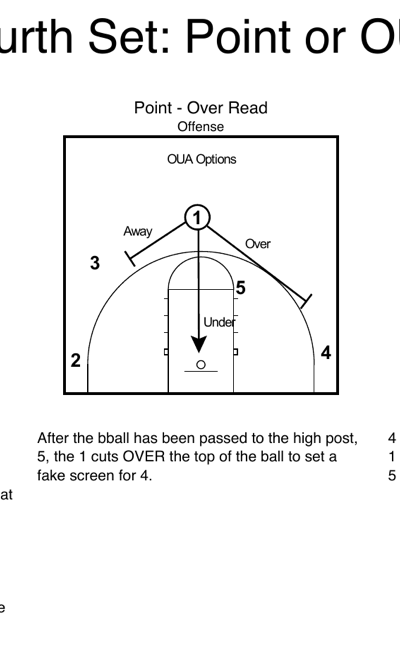
The OUA Options — Away, Over, and Under reads from the Point entry
Point Away
Point Away is triggered when the defender chases the guard away from the ball-handler. The guard cuts away from the ball, executes a fake screen that wrong-foots the chasing defender, and creates an immediate scoring window. From that cutting action, the offense reads two secondary options: the POST option, where the guard seals for a direct entry to the block, and the FLARE option, where the guard pops to the corner or wing off a flare screen set by the four or five player.
Point Away is the read you want most often, because it creates the most direct path to a high-quality shot. When your players run it correctly, the guard is getting a layup or a corner three off the flare. Defenses that try to front the cutter create the POST option. Defenses that hedge against the flare create the direct cut. There is no safe answer for the defense once the guard goes Away.
Read the full Point Away breakdown →Point Over
Point Over is triggered when the defender fights over the screen to stay attached to the guard. Rather than continuing away, the guard pops back toward the ball. This brings the ball-screen action into play — the screener rolls or pops depending on their defensive match-up, and the ball-handler reads the roll-and-kick options that open as the defense collapses. Point Over is effective against teams with aggressive individual defenders who are determined not to give up the catch in space.
The kick-out reads from Point Over create the most open three-point looks in the entire offense. When the defense commits to stopping the roll, the corner and wing players are wide open. When they spread to cover the perimeter, the roll player is alone at the rim. This is classic ball-screen basketball built into a read-based framework rather than a scripted play.
Read the full Point Over breakdown →Point Under
Point Under is triggered when the defender concedes the screen by going underneath it, giving up the catch at the arc in exchange for taking away the direct cut. The guard cuts under the screen toward the baseline, and the offense flows into baseline action. This is the most situational of the three Point reads — you will see it most against teams that have been burned by the Away action and adjust by going under to take away the backdoor.
Read the full Point Under breakdown →How the Sets Connect
One of the features that separates the Princeton Offense from other read-based systems is that the six sets are genuinely interchangeable. Your players do not just know six sets — they know how to transition between sets within a single possession based on what the defense gives them. Here are the primary connection points coaches need to understand when installing the full system.
Dribble up from Five Out keys Chin. When the ball-handler drives off the Five Out formation into the lane, the spacing and cutting principles shift immediately into Chin action. The players away from the ball read the drive and fill accordingly. This is one of the most natural transitions in the system and requires very little additional teaching once players understand both sets.
Pass up from Five Out keys Point. When the ball is passed up top from the Five Out formation rather than driven, the offense reads into Point action. The guard at the top initiates the Point Set reads — Away, Over, or Under — and the offense continues from there. This is why Five Out is the most important transitional set in the system. Every possession that starts in Five Out has a defined path forward based on whether the first action is a dribble or a pass.
Low Set transitions into Chin on reversal. When the ball is reversed out of the Low Set, the re-positioning of players moving back up the floor re-creates the Chin alignment naturally. Rather than calling a separate action, the reversal itself keys the transition. Players who understand both sets will recognize the Chin reads as soon as the reversal pass is made and execute without a verbal call from the bench.
Twirl and X Set create constant motion. Neither the Twirl Set nor the X Set is designed to isolate into a single read and stop. Both sets are built for continuous movement that keeps the defense rotating and creating gaps in coverage. When you install both sets together in weeks five through eight, your offense gains the capacity to maintain pressure over an entire shot clock without a designed play call. That is when the Princeton Offense becomes truly difficult to scout and defend.
The Counter System
Every read in the Princeton Offense has a built-in counter for every defensive adjustment. Switching man-to-man, trapping the ball-handler, denying the entry pass, zone rotations, and full-court pressure all have specific counter packages built into the system. In total, the Princeton Offense contains fourteen counter packages that address every defensive scheme a team might throw at you.
The counter system is what makes the Princeton Offense sustainable at higher levels of competition. At the youth and high school level, the basic reads are often enough to generate good shots because defenders are not disciplined enough to take away multiple reads in sequence. At the college level and against experienced coaching staffs, you will face defenses that have specifically prepared for your Chin and Point action. The counter system is your answer to that preparation. When a team has scouted you thoroughly and taken away your primary reads, the counters create the next layer of offense that they have not prepared for.
Understanding the counter system also changes how your players read the defense. Instead of seeing a defensive adjustment as a problem, they learn to see it as information. A hard switch on the Point Set keys the POST action. An aggressive trap on the Chin entry keys the skip pass counter. Denial of the wing pass keys the backdoor. The defense tells your players what to do — your players just need to speak the language.
Practice Progression: Installing the System Week by Week
The single biggest mistake coaches make with the Princeton Offense is installing too many sets too quickly. The system rewards patience. Each set builds on the reads learned in the previous set, and players who understand the foundation run the advanced sets faster and more accurately. Here is the progression I use with every team I coach.
| Weeks | Focus | What Players Learn |
|---|---|---|
| Weeks 1–2 | Chin Set | Spacing, dribble weave entry, the three foundational reads: entry, cutter, continuation. Every player runs every position. |
| Weeks 2–3 | Backdoor Reads | Reading over-playing defenders, timing the cut, finishing at the rim. Defender behavior drives the read. No pre-determined cuts. |
| Weeks 3–4 | Point Series | The 1-4 alignment, reading the defender on the screen, executing Away and Over reads. Point Under introduced at the end of week 4. |
| Weeks 4–5 | Low Set | Below-the-line spacing, post reads, transition from Low Set back into Chin on reversal. Connecting two sets within one possession. |
| Weeks 5–6 | Twirl Set and Five Out | Continuous rotation mechanics in the Twirl Set. Five Out spacing and the two key transitions: dribble-up to Chin, pass-up to Point. |
| Weeks 6–8 | X Set and Counter Packages | Cross-screen and pin-down reads in the X Set. All fourteen counter packages installed in response to specific defensive adjustments. |
Two important notes on this progression. First, do not move to the next phase until players are executing the current phase without hesitation. Speed of recognition matters more than speed of movement. A team that reads the Chin Set correctly at a moderate pace will beat a team that runs it fast but sloppy every time. Second, use breakdown drills at every phase — the 2-on-2 read drill, the 3-on-3 entry drill, and the 4-on-4 continuation drill build the reads in smaller groups before you add the full five-player complexity.
For a complete session-by-session schedule with drill minutes, transition points, and evaluation criteria, the Princeton Offense practice plan has everything you need from day one through the end of the installation period.
Where to Go From Here
This page is your hub for every action in the Princeton Offense. Use the links throughout to go deep on any set or read you want to master. If you are just starting with the system, begin with the Chin Set and work through the progression in the order outlined above. If you are already running the offense and want to add a layer, the counter packages are where experienced programs find the most immediate value.
For the complete system in one place — all six sets, all fourteen counters, 42 breakdown drills, and the full practice progression with diagrams — the Princeton Offense Mastery Blueprint is the 87-page playbook built from 25 years of coaching this offense at every level. Everything on this site points back to that resource because it contains what the individual pages cannot: the full integration of how every piece fits together in a real practice and a real game.
Get the Complete Princeton Offense System
Six sets. Fourteen counters. 42 breakdown drills. 87 pages of diagrams, reads, and installation notes — everything you need to implement the Princeton Offense with your team. Written by Coach Lee DeForest, with 25 years of coaching experience at every level.
Get the System — $39