Point Away Action in the Princeton Offense

7 min read

What Is the Point Away Action?

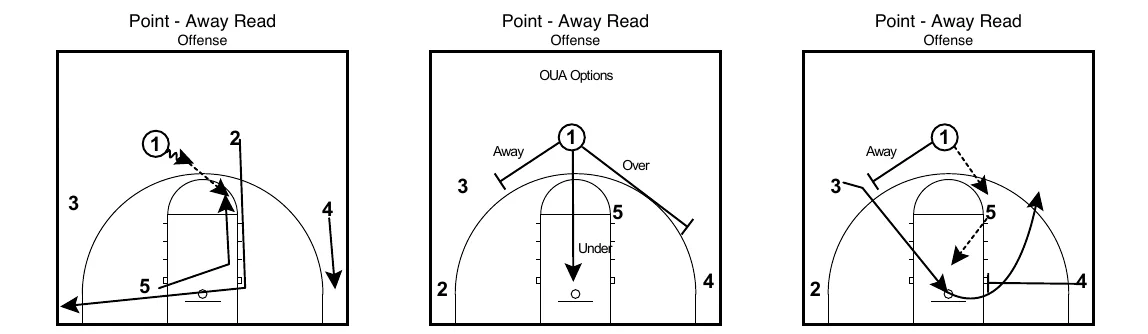
The Point Away is one of the three reads in the Point series (also called the OUA series) and it is my favorite entry into backdoor action on the weakside of the floor. When the ball goes into the high post, the passer has three choices: Over, Under, or Away. The Away read sends the passer to the opposite side of the ball to set a screen, and the chain reaction that follows creates layups, open threes, and driving lanes that most defenses simply cannot handle.

Also known as ROD-2 or the Rod 2 Action in some coaching systems, this read is built on deception. The passer does not cut toward the ball or toward the basket. Instead, they walk away from the action, and that misdirection is what makes the whole thing work.

Point Away Entry court diagram
Point Away Entry
Point Away Read court diagram
Point Away Read
The Point Away read is determined by the passer after the ball goes to the high post. The 4 passes the ball into the 5 at the elbow, and what happens next depends entirely on the defensive reaction. — From the Princeton Offense Playbook

Setup and Initial Alignment

Before the Away read can happen, we need to get the ball to the elbow. The most common entry is through the Point Set, but you can also arrive here off a post dribble-up from the Low series.

Starting Positions

  • 1 (Point Guard) — Top of the key with the ball, or wing position after the initial pass rotation
  • 5 (Post) — High post at the elbow, ready to receive the entry pass
  • 4 (Forward) — Top of the key or wing, making the entry pass to 5
  • 2 (Shooting Guard) — Wing or corner opposite the ball
  • 3 (Wing) — Wing on the ball side, typically below the free throw line extended

The action begins once the 4 delivers the pass to the 5 at the elbow. At that moment, the 4 reads the defense and chooses the Away cut. This is the trigger for everything that follows.

Point Away: Primary Reads and Options

Here is the progression, step by step. I want my players thinking sequentially through these reads, not freelancing.

Read 1: The Fake Screen Away

After the ball is passed to the high post (5 at the elbow), the 1 cuts away from the ball to set a fake screen for the 3 on the weakside wing. This is the defining movement of the Away read. The 1 is not screening to free the 3 for a catch. The 1 is using the appearance of a screen to create confusion in the defensive coverage.

The defense has to decide: does X3 fight over the screen? Does X1 switch? Does help come from the weak side? Every one of those decisions opens a different option for us.

Read 2: Ball Reversal Back to 1

After the fake screen, the 5 passes back to the 1. The 1 now has the ball on the wing or at the top of the key, and the defense is already shifted out of position from reacting to the screen action. This is where the real damage starts.

Read 3: Ball Screen with 5 (No Roll)

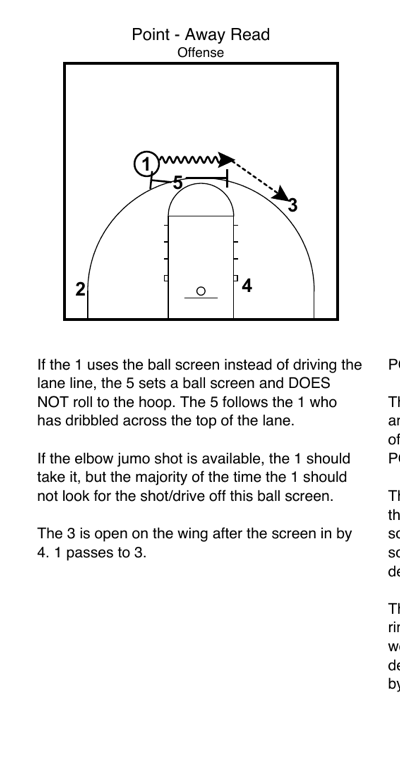
If the 1 uses the ball screen instead of driving the lane line, the 5 sets a ball screen and does NOT roll to the hoop. This is critical. The 5 follows the 1 who has dribbled across the top of the lane. The reason we do not roll is because the next action depends on the 5 being in a screening position, not on the block.

If the elbow jump shot is available, the 1 should take it. But the majority of the time, the 1 should not look for the shot or drive off this ball screen. The ball screen is a setup, not a finishing action.

Read 4: Wing Pass to 3

The 3 is open on the wing after the screen-in by the 4. The 1 passes to 3. This wing pass keys a special set that I call the Post and Flare Option. This action is common throughout the offense and is one of the most effective scoring sequences we run.

Read 5: Post/Flare Action

Once the 3 catches on the wing, two things happen simultaneously:

  • Post option — The 3 looks inside first for the high-low feed
  • Flare screen — The 5 sets a flare screen for the 1. The 3 passes the ball to the 1 coming off the flare

The action of the ball screen into a flare screen is extremely difficult to defend for X1. The defender on the 1 has just fought through a ball screen, and now immediately has to navigate a flare screen going the opposite direction. That is two screens in rapid succession with a change of direction.

Read 6: Drive and Kick

The 1 receives the ball off the flare and drives to the rim. The lane is cleared on the weakside after the flare screen. Many times the defender on the 2 (X2) will help to stop the drive by 1, which leaves the 2 open for a three-point shot on the weakside.

This is the full sequence. Fake screen, ball reversal, ball screen, wing pass, flare screen, drive-and-kick. Six reads, one continuous flow of movement.

Coaching Points

The Fake Screen Must Look Real

If the 1 jogs to the weakside, the defense will ignore it. The fake screen needs to look like a real screen. The 1 needs to sprint to the screening angle, plant their feet, and sell the contact. Only then does the misdirection work. The defense has to believe a screen is coming in order to react to it.

5 Does Not Roll on the Ball Screen

I cannot stress this enough. The natural instinct for a post player is to roll to the rim after a ball screen. In the Point Away, the 5 must follow the ball handler across the top of the lane. The flare screen that comes next is what makes this action lethal, and it only works if the 5 is in position to set it.

Read the Defense Before Choosing Away

The Away read is one of three options in the Point series. The passer should choose Away when the defense is overplaying the ball side or when the weakside defenders are ball-watching. If the defense is sagging back, the Over read is usually the better choice.

Elbow Jump Shot is Always an Option

After the ball reversal back to the 1, if the elbow jumper is there, take it. Do not force the ball screen sequence if the defense has already given you a clean look. The offense rewards players who take what the defense gives them.

Use Spin to Change Sides

If the initial entry does not produce a scoring opportunity, this is a good time to run SPIN (pass fake to reverse the ball) and reset the action to the opposite side of the floor. The defense has already been moved, and running the same reads from the other side doubles the pressure.

Connection to Other Princeton Actions

The Point Away does not exist in isolation. It is one piece of a system where every action flows into the next.

  • Point Over — The Over read sends the passer over the top of the ball. If the defense adjusts to take away the Away read, switching to Over keeps them off balance.
  • Point Under — The third option in the OUA series. The passer cuts under the ball toward the basket. This is the most direct scoring cut in the series.
  • Chin Set — The Chin entry often leads into Point action through the dribble weave. If the initial Chin action does not produce a shot, the ball can move to the elbow and trigger the OUA reads.
  • Post Dribble-Up — When the 5 is a capable passer, the post dribble-up from the Low series naturally feeds into the Point alignment. The 5 dribbles up the lane line, the 2 cuts backdoor, and if nothing opens, the offense resets into Point formation.
  • Wave Series — The Wave is a counter to defensive overplay on the 2 in Chin. It has three options (Away, Over, Under) that mirror the Point series reads. Players who know Point Away already understand the Wave Away concept.

The complete Princeton Offense system is built so that every set connects to every other set. When your players understand this, the defense can never fully take away one action without opening another.

Practice Drill: Point Away 3-on-0 Walk-Through

Before you run this live, walk through it. I use the 1, 3, and 5 positions for the initial rep.

  • Step 1: 4 enters the ball to 5 at the elbow. Call "Away" so every player on the floor knows the read.
  • Step 2: 1 sprints to the weakside and sets the fake screen for 3. Hold the screening position for a full count before releasing.
  • Step 3: 5 passes back to 1. The 1 catches and faces up.
  • Step 4: 5 sets the ball screen. The 1 dribbles across the top. The 5 follows (no roll).
  • Step 5: 1 passes to 3 on the wing. 5 immediately sets the flare screen for 1.
  • Step 6: 3 passes to 1 off the flare. 1 drives to the rim.

Run this walk-through five times on each side, then add defenders. Build the habit before you add the pressure.

Get the Complete Princeton Offense System

Six sets. Fourteen counters. 42 breakdown drills. The complete system with all diagrams, reads, and counters. From Coach Lee DeForest, with 25 years of coaching experience.

Get the System — $39