Point Over Action in the Princeton Offense
8 min read
What Is the Point Over Action?
The Point Over is one of the three reads out of the Point Series in the Princeton Offense. After the ball is entered to the high post, the point guard cuts over the top of the ball — toward the ball-side — to set a fake screen for the wing player on that side. That single cut triggers a chain of reads that can produce a layup, a ball screen attack, a kick-out three, or a high-low pass. It is one of the most versatile scoring sequences in the entire system.
Also known as ROD-1 or the Rod 1 Action in some coaching systems, the Point Over read is distinguished from its counterparts — Point Away and Point Under — by the direction of the point guard's cut relative to the ball.
If you have watched Princeton, Air Force, or any college program that runs this offense seriously, you have seen the Point Over create open shots in late-clock situations over and over. It works because the defense has too many things to guard at once, and every read cascades into the next one.
When to Use Point Over
The Point Over read is available any time the ball has been entered to the 5 at the high post from the Point alignment. I teach my players that the three Point Series cuts — Away, Over, and Under — should be mixed based on what the defense is giving you. But there are specific situations where Point Over is the strongest call:
- The defense is overplaying the weakside. When defenders are anticipating the Point Away backdoor cut, going Over catches them off-guard because the action moves toward the ball instead of away from it.
- Your point guard can attack off a ball screen. The Point Over sequence ends with a side pick-and-roll between the 1 and the 5. If your point guard is a capable driver, this is where you want to put them.
- You need a late-clock scoring option. The ball screen creates a two-man game with multiple outlets. Even if the initial reads are taken away, the pick-and-roll gives you a reliable way to generate a shot.
- The opponent traps ball screens. Point Over has a built-in counter for trapping defenses that produces high-percentage high-low passes for layups.
Setup and Alignment
The Point Over begins from the standard Point alignment. This is a 1-4 set with the point guard (1) up top, the 5 at the high post, and the remaining three players spaced on the wings and corners:
- 1 (Point Guard): Top of the key with the ball.
- 5 (High Post): At the elbow or free-throw line area.
- 2 (Wing/Corner): Ball-side wing, waved through to the corner during the initial entry.
- 3 (Weakside Wing): Positioned above the weakside elbow.
- 4 (Wing): Weakside wing or corner area.
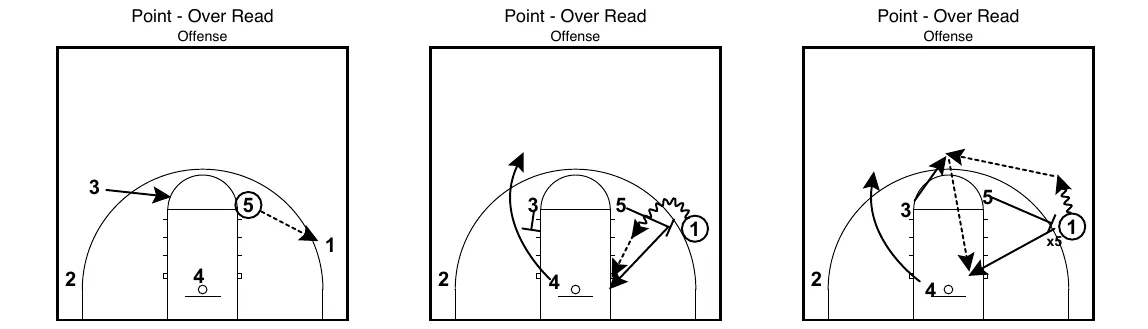
The action starts when the 1 passes to the 5 at the high post. Before the Over cut begins, the 2 is waved through — they cut through the elbow as the 5 catches, and the 5 cuts to the opposite block to get position. The 2's cut through the lane acts as a kind of brush screen to help get the 5 open at the elbow. As the 2 cuts through, the 4 drops to the corner to protect against a blindside steal.
Primary Reads and Options
Read 1: The Over Cut and Backdoor Look for 4
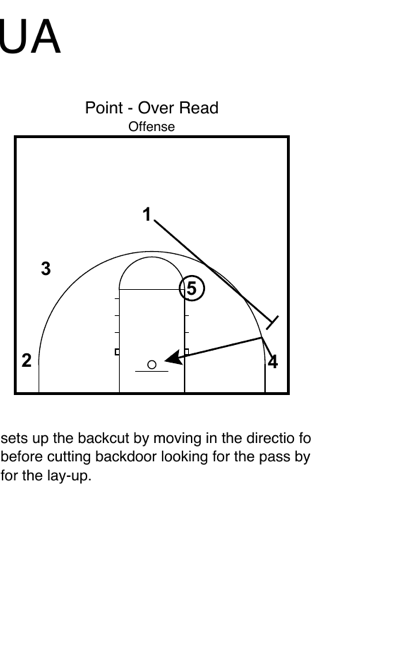
After the ball is entered to the 5 at the high post, the 1 cuts over the top of the ball — moving toward the ball-side — to set a fake screen for the 4. The 4 reads this action and sets up a backdoor cut by first moving toward the 1 (selling the screen), then cutting hard backdoor looking for the pass from the 5 for the layup.
This is the first scoring option. If the defense is anticipating the screen and the defender on 4 jumps toward the ball, that backdoor cut is wide open. The 5 must see this and deliver the pass on time.
Read 2: 1 Pops Back for the Ball
After the fake screen, the 1 pops back out to receive the pass from the 5. This is a critical detail: the 1 must not be in the corner on the catch. They need to be above the wing area to set up the ball screen attack that follows. If the 1 is denied on the pop-out, they go backdoor immediately for the layup — the backdoor is always there.
Meanwhile, the 4 finishes the cut all the way to the rim. Even if 4 does not receive the backdoor pass, they clear through to create spacing for what comes next.
Read 3: The Side Ball Screen
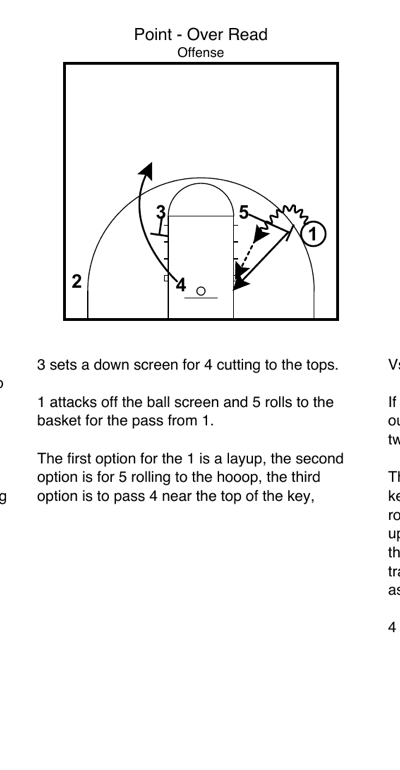
Once the 1 catches the pass back from the 5, the action transitions into a side pick-and-roll between the 1 and 5. The 3 moves above the weakside elbow to set a down screen for the 4 — and to read how the defense is going to play the ball screen.
The 1 attacks off the ball screen from the 5. The 5 rolls hard to the basket. The reads cascade in order:
- First option: The 1 turns the corner for the layup.
- Second option: The 5 rolling to the basket for the drop-off pass from 1.
- Third option: The 4 popping to the top of the key off the down screen from 3 — open for the catch-and-shoot three.
Read 4: Counter vs. the Trap
Here is where Point Over separates itself from a basic ball screen action. If the defense traps the ball screen, there is a built-in counter that I have seen produce wide-open layups at every level I have coached.
When the defense traps, the 1 strings out the trap by dribbling higher and pulling the two defenders away from the basket. The 3 reads the trap and sprints to the top of the key for the pressure-release pass. The 5, who set the ball screen, has already rolled to the basket. Once the 3 catches the pass up top, the ball is immediately swung to the 5 for the layup.
This high-low attack works because the 1 does the hard work of pulling the trap away from the rim. As long as the 3 cuts for the ball up top and the 5 finishes the roll, it is a layup almost every time. The 4 clears out to the top to keep spacing clean.
Read 5: Reset Into Continuity
If there are no options off the ball screen and the defense is not trapping, the 1 simply dribbles up to the guard spot. The 4 cuts off the down screen from the 3 for the pass from 1. The 2 fills the wing spot. The 5 has already rolled to the basket. From here, the offense resets and you are right back into the flow — ready to run another action out of Chin, Low, or any other set in the system.
Air Force Version
In the Air Force version of this offense, the 3 becomes the new POST player after the Point Over sequence, and the 5 fills the wing position. This is only for one possession — positions change on the next offensive possession.
The 1 reverses to the 4, who then passes to the 2 on the wing. The new POST (3) is now prepared to begin the Strongside phase and is ready to set the UCLA screen for the 4 cutting to the hoop. This version keeps the defense from settling in because the post player changes every possession.
High School Version
In the high school version, most coaches will want to keep their POST player in a familiar position. I have taught this version to dozens of teams and here is how it works:
The 1 has no options off the ball screen by the 5, and the roll option is not open. The 1 passes to the 3 coming to the top. There is no down screen in this version — the 4 fills the open corner spot instead of cutting to the top of the key.
After the pass to the 3, the 1 fills the corner spot and the offense is now in the Point phase again. The 3 passes to the 5 and executes one of the three cuts of the Point Series. I generally recommend going into Point Away at this point because the weakside defense tends to get lazy, which opens up the backdoor cut.
At any point as the 5 is moving to set the side ball screen, if the defender on 1 plays too high anticipating the ball screen, the 1 should drive the baseline for the layup. It is a good idea to at least set the defense up with a hard dribble baseline before crossing over into the ball screen. Do not do this every time, but it is a tactic that prevents the defense from getting comfortable.
— Coach Lee DeForest
Coaching Points and Common Mistakes
- The 1 must not catch in the corner. If the 1 drifts too deep on the pop-out after the Over cut, the ball screen angle is destroyed. They need to catch above the wing extended so they have room to attack off the screen.
- The fake screen must look real. The 1's Over cut toward the 4 must sell the screen. If the 1 jogs through, the defense will not react and the backdoor for 4 will not open. Make it look like a screen, then pop back out.
- The 5 must roll hard. After setting the ball screen, the 5 cannot stand and watch. They roll to the basket with their hands ready. The drop-off pass from the 1 only works if the 5 is already moving toward the rim.
- Read the trap early. The 3 must recognize the trap before it fully forms. If the 3 is late sprinting to the top of the key, the high-low pass to the 5 is not there. Teach the 3 to read the trap as it happens, not after.
- The backdoor is always available. At every point in this sequence, if a defender overplays, the immediate answer is a backdoor cut. This is not optional — it is the fundamental rule of the Princeton Offense.
- Spacing collapses kill the action. If the 2 does not clear properly or the 4 does not fill the corner, the lane gets clogged and the ball screen attack has nowhere to go. Drill the spacing until it is automatic.
How Point Over Connects to Other Actions
The Point Over does not exist in isolation. It is one piece of a system where every action flows into every other action. Here is how it connects:
- Point Away: The Point Away read is the counterpart to Point Over. If the defense starts cheating toward the Over cut, you call Away and the weakside backdoor opens up. Mixing the two keeps the defense guessing.
- Chin Set: When the Point Over resets, the offense can flow directly into the Chin dribble weave. The 1 dribbles up to the guard spot and the players relocate into Chin alignment.
- 5 Out: If the 4 catches at the top off the down screen, they can attack middle with the dribble and locate the 2 in the corner for the three-point shot. This puts you into a 5-Out spacing concept.
- Strongside Phase: In the Air Force version, the new POST player (3) initiates the Strongside phase with a UCLA screen. This is a natural extension of the Point Over action.
Practice Drills for Teaching Point Over
Drill 1: Over Cut and Pop (5 minutes)
Set up with the 1, 5, and 4 only. The 1 passes to the 5, cuts Over, fakes the screen on 4, and pops back for the pass. No defense. Focus on the 1 not drifting to the corner. Run 10 reps each side, then add a passive defender on the 1 to practice the backdoor read on the pop-out.
Drill 2: Backdoor Timing (5 minutes)
Same three players. The 4's defender overplays toward the ball. The 4 must read it, sell the screen approach, and cut backdoor for the pass from the 5. Emphasize the timing — the 4 must wait for the 1's Over cut before making the backdoor move. The 5 must deliver the pass on the cut, not after the 4 has stopped.
Drill 3: Ball Screen Reads (8 minutes)
Add the 3 and run the full ball screen sequence. The 1 catches the pop-out pass, the 5 sets the ball screen, and the 1 attacks. Rotate through the three options: layup for 1, roll pass to 5, kick to 4 at the top. Add a trap scenario where the 3 must sprint to the top for the release pass. Run 4 reps of each scenario.
Drill 4: Full Point Over Live (10 minutes)
Five-on-five, half-court. The offense runs Point Over exclusively. The defense plays live. After each possession, identify which read was open and whether the offense found it. This is where your players learn to see the reads in real time instead of memorizing a play. Run for 10 minutes or 15 possessions, whichever comes first.
Drill 5: Point Series Mix (8 minutes)
Five-on-five. The point guard calls Away, Over, or Under after the entry pass to the 5. The defense does not know which cut is coming. This is the final progression — your players must execute all three reads and the defense must guard all three. This is how you build a Princeton offense that cannot be scouted.
Get the Full System
The Point Over is one of 7 core actions in the Princeton Offense system I have built over 25 years of coaching. Each action has its own reads, counters, and connections to every other action. When your team knows all seven, the defense cannot take away your offense — they can only pick which action they want to give up.
Get All 7 Actions in the Complete 87-Page Playbook
Every action. Every read. Every counter. 42 breakdown drills. The complete Princeton Offense system with full court diagrams, coaching points, and game-ready progressions. From 25 years of coaching experience.
Get the Full SystemFrequently Asked Questions
What is the difference between Point Over and Point Away?
In Point Over, the point guard cuts toward the ball (over the top) after the entry pass to the high post. In Point Away, the point guard cuts away from the ball toward the weakside. The Over cut creates a ball screen attack on the ball-side, while the Away cut creates backdoor opportunities on the weakside. I teach both and mix them based on what the defense is giving us.
Can I run Point Over without a dominant point guard?
Yes. The ball screen attack at the end of the sequence is just one of the reads. If your point guard is not a strong driver, emphasize the backdoor cut for the 4, the pop-out three for the 4 off the down screen, and the high-low trap counter. The system gives you multiple scoring options that do not require one player to dominate.
How do I teach Point Over to a high school team?
Start with the simplified high school version described above — no down screen, the 4 fills the corner, and the offense resets into the Point phase. Once your players are comfortable with the basic reads, add the down screen for the 4 and the trap counter. Build it in layers over two to three weeks of practice.
What is the ROD-1 action?
ROD-1 is another name for the Point Over read used in some coaching systems. The "ROD" designation comes from different nomenclature used by coaches who adapted the Princeton Offense for their own programs. The action is the same — the point guard cuts over the top after the high post entry, triggering the ball screen sequence.