Point Under: The Princeton Offense Under Read
8 min read
What Is the Point Under Read?
The Point Under is the third read in the Point Set of the Princeton Offense. Where the Over Read sends your point guard attacking over a ball screen, and the Away Read shifts action to the weakside wing, the Under Read takes a completely different path — your point guard cuts baseline, sprinting to the rim off the high post entry, and the entire offensive sequence unfolds from that cut.
This is called the Under Read because the 1 goes under the ball — cutting baseline below the high post rather than popping back out or going over a screen. That simple change in direction opens an entirely different set of scoring actions: a rim cut from the 1, a pin-down screen from the 5 for the 4 coming to the wing, a high/low option back into the post, and ball reversal sequences that keep the defense scrambling from side to side.
In the playbook, this action is sometimes referred to as the OUA — which stands for the three reads available from the Point Set: Over, Under, and Away. Knowing all three is what makes the Point Series complete. If a defense shuts down the Over and the Away, the Under is your answer. If they start cheating to take away the Under, you go back to the Over or the Away. The reads force the defense to be wrong in one direction every time the action is called.
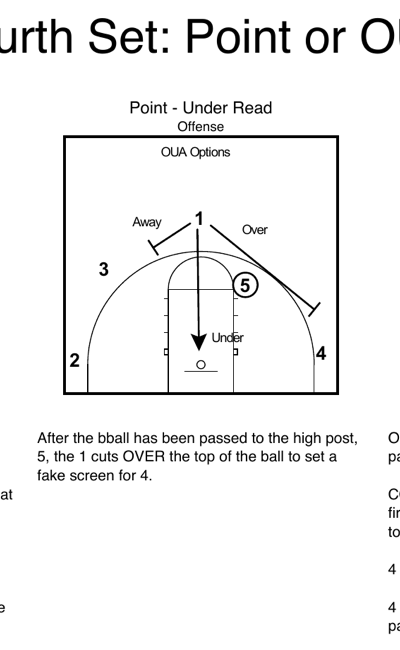
OUA read options — Over, Under, and Away from the same entry.
Setup and Alignment
The Point Under grows out of the same initial alignment as every other read in the Point Set. Before the Under cut happens, your players need to be in these positions:
- 1 (Point Guard) — up top with the ball, about to make the entry pass to the high post (5). This is the same first move in every Point Set action — the high post entry.
- 5 (Center/High Post) — at or near the elbow. Receives the entry pass from 1 and is now the hub of the action, with reads available to the rim, the wing, and the elbow.
- 4 — initially positioned on the strongside, will be moving through the lane during the action. In the high school version, 4 and 5 are the two post players — both sides of the lane are covered by these two players.
- 3 — on the weakside wing, spacing the floor and ready to receive ball reversal.
- 2 — on the strongside wing, holding floor balance.
The high post entry triggers everything. When 1 passes to 5 at the high post, the defense must account for the high post player with the ball. That moment of attention on 5 is exactly when 1 cuts — not back out to the top, but baseline, sprinting toward the rim on the strongside. The timing of this cut off the entry pass is what makes the action work. A late cut kills it.
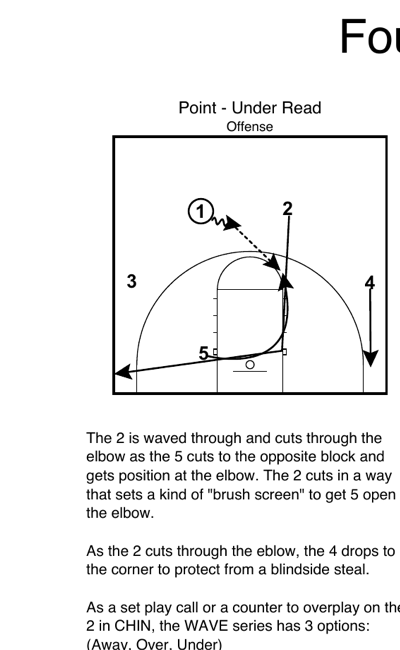
Initial setup: waves through the elbow before the high post entry.
This is the same alignment used in the CHIN set and the Wave Series reads. The playbook describes the Point Under as one of three reads available whenever the ball is passed up to the high post — the defense's adjustment to the first two reads is what makes the third one available.
The Read Progression — Step by Step
Once 1 makes the entry pass to 5 at the high post, here is the full sequence for the Under Read:
Step 1 — 1 Sprints Baseline to the Rim
The moment the ball goes to 5 at the high post, 1 does not pop back out to receive a return pass. Instead, 1 sprints hard to the rim on the baseline side — cutting under the ball. This is a genuine scoring cut, not a clearing action. 5 looks for 1 immediately on the sprint to the rim. If 1 is open at the basket, the pass goes there first and the action is finished with a layup.
The playbook is direct about this: the 1 will sprint to the rim for the pass back from 5. The cut must be hard. A casual jog to the rim does not put pressure on the defense and does not threaten the basket. Sprint the cut every time.
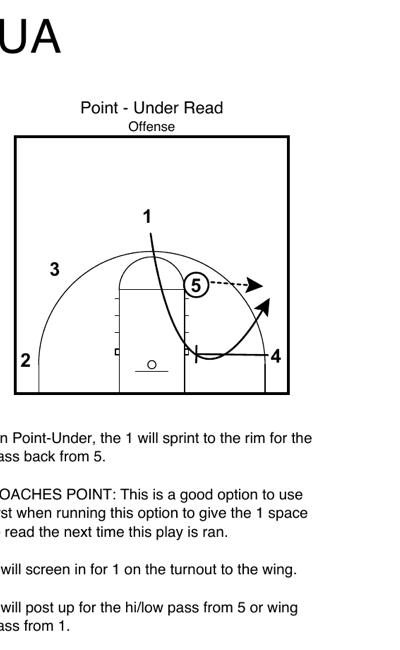
1 sprints baseline to the rim; 5 looks for the pass immediately.
Step 2 — 4 Screens In for 1 on the Turnout
If 1 does not receive the pass at the rim, 1 continues the cut and uses a screen from 4. The 4 sets a screen to help 1 turn out to the wing. This is a built-in counter to a defense that cheats to cut off 1's baseline path — 4 steps up and gets in the way, giving 1 a clean angle to the wing.
This screen from 4 is described in the playbook as a key part of the action. The 4 sets the screen and then immediately posts up hard for a hi/low entry from 5 or a wing entry from 1 after they reach the wing. 4 is not just a screener — 4 is a scoring option the moment the screen is set.
Step 3 — 1 Receives on the Wing, 5 Reads the Hi/Low
When 1 comes off 4's screen and receives the ball on the wing, the offense now has two immediate options running simultaneously. First, 5 makes a duck-in move from the elbow toward the block — looking for the hi/low pass from 1. If the post entry is there, the ball goes inside and the action becomes a low post set. Second, 4 has posted up on the block after setting the screen and is available for a direct wing entry.
The read belongs to 1: pass to 4 posting, hit 5 ducking in, or advance the ball to the top for the next read sequence.
Step 4 — 5 Sets a Pin-Down Screen for 4
On the pass from 1 to 2 on the opposite wing — or when the ball is reversed away from the strongside action — 5 moves to set a weakside down screen for 4. The 4 uses this screen to cut to the top of the key or elbow area. As the playbook notes: "Many times, the 4 will be wide open at the key for the shot on this down screen action." This is a built-in scoring opportunity that defenses regularly give up when they are busy tracking the ball movement and the initial rim cut.
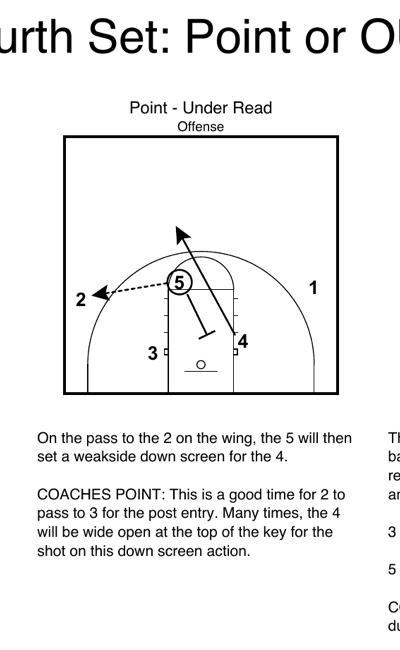
Ball goes to 2 on wing; 5 moves to set the weakside down screen for 4.
Step 5 — Ball Reversal and the Wing Options Read
When 4 catches the pass and reverses the ball to 1 on the weakside wing, the offense transitions back into its standard wing options sequence. The 5 moves to the elbow on the pass from 4 to 1. The 3 fills the corner spot. From here, the 1 has the same three wing options that appear throughout the Point Series:
Wing Option 1: If the post is open, pass there first and work out of the low post set.
Wing Option 2: If the post is not open, pass to the top and initiate the Point OUA set options again.
Wing Option 3: If there are no options available, dribble to the guard spot and re-enter CHIN. The offense never stalls — it resets and runs the reads again.
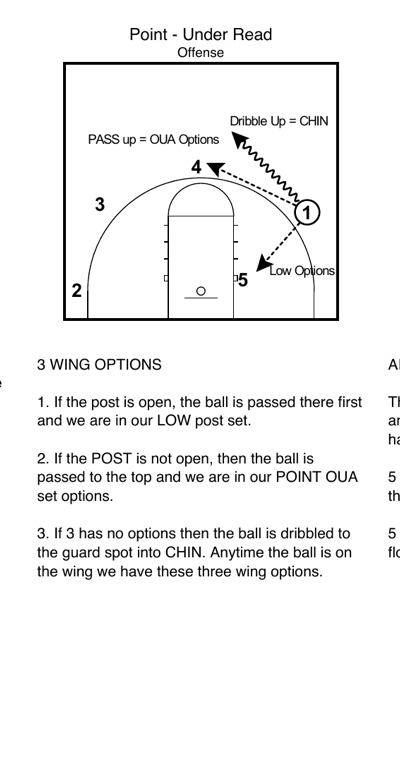
Wing options read: post entry, pass to top, or dribble up to CHIN.
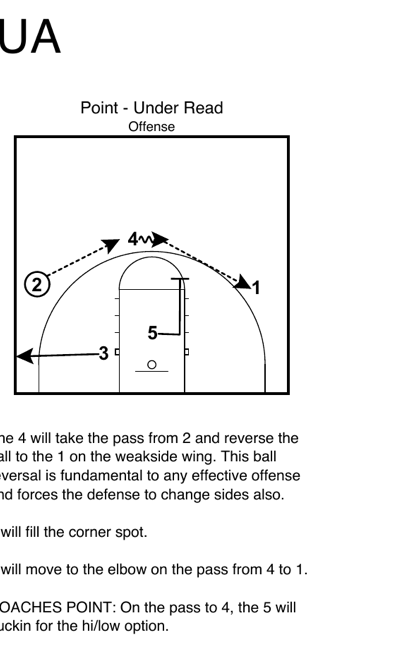
Ball reversal: 4 catches from 2, reverses to 1 on the weakside.
Baseline Action and Scoring Options
The Point Under generates scoring opportunities at multiple stages of the action. Understanding all of them is what separates teams that run this read well from teams that run it once and settle for whatever happens after the initial cut. Here are the primary scoring options in sequence:
The Rim Cut — First Option
The rim cut from 1 off the high post entry is the first and best option. A defense that is tracking the ball going to 5 and not anticipating a baseline cut from 1 will give up a layup here every time. The key is that 5 must look for 1 immediately — not after processing two or three other reads. The cut and the look from 5 must happen together.
Coaching point: The playbook specifically notes that this is a good option to use the first time you run Point Under in a game. Using the rim cut early teaches the defense to watch for it — and that defensive awareness sets up the pin-down and ball reversal options later. Run the rim cut first to earn respect for it, then use the secondary options when the defense adjusts.
The 4 Post-Up — Second Option
After 4 screens for 1 and posts up, the 4 is in good position for a direct entry from either 5 (hi/low) or from 1 on the wing. This is not a secondary option in the sense of a bailout — it is a designed post-up that the screen creates. The 4 should establish position hard and hold it. If 5 passes to 1 on the wing and 4 has inside position, the wing-to-post entry is one of the most reliable feeds in the offense.
The 5 Duck-In — Third Option
The duck-in from 5 at the elbow is a high/low option that appears after 1 reaches the wing. 5 reads the defense — if the defender on 5 is pinching off the passing lane to 4, 5 ducks in toward the block and looks for a direct feed from 1. This option requires 5 to be active and aware. A passive 5 standing at the elbow does not threaten the defense. An aggressive 5 sealing a defender below the elbow forces the defense to make a choice between covering 4 and covering 5.
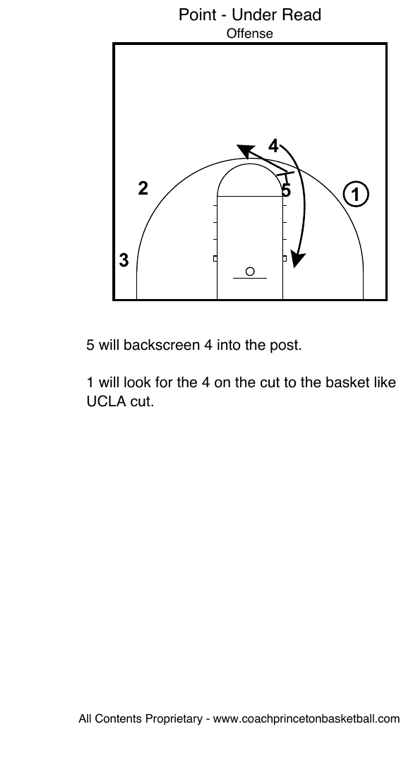
5 backscreens 4 into the post; hi/low entry opportunity for 1 on the wing.
The Pin-Down for 4 — Fourth Option
The pin-down screen from 5 for 4 on the weakside is the delayed scoring option — it arrives after ball reversal. But it is a real shot, and the playbook calls it out specifically because the 4 is often wide open at the top of the key. A defense that has been following the ball through the rim cut, the screen action, and the wing pass will frequently lose track of 4 moving off 5's screen. This is a three-point opportunity or a short pull-up — high percentage for a player who has earned a clean look at the end of the action.
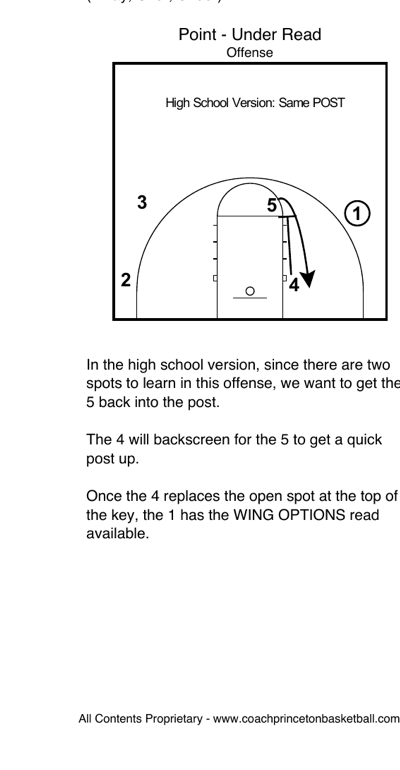
High school version: 5 backscreens for 4 in the two-post alignment.
The Under Read is not just one cut. It is a sequence. Every player is moving with a purpose at every moment, and the scoring options stack on top of each other as the action unfolds. Run it the right way and the defense is making five separate decisions in ten seconds. They will get one wrong.
— Coach Lee DeForest
When to Use Point Under
The Point Under is the right call in several specific situations:
- When the defense is cheating on the pop-out. If a defender is anticipating 1 popping back out to receive the return pass from 5, the Under cut goes the opposite direction and catches them completely unprepared. Denial of the pop-out is an invitation for the baseline cut.
- When you have a post threat at the 4. The Under Read gives 4 two separate opportunities to post up — after the screen for 1, and after the pin-down on the weakside ball reversal. If your 4 is a skilled post scorer, this action is designed to get them the ball in good position.
- When the Over and Away reads have been shut down. The defense cannot stop all three reads at once. If they have been successfully defending the ball screen (Over) and the weakside action (Away), bring the Under. The same initial alignment produces a completely different attack path.
- When you want to create scoring off ball reversal. The Point Under generates multiple ball reversals, each with a read attached. If your team is better at scoring off ball movement than off isolation or pick-and-roll, the Under Read plays to that strength.
- When you want to set up the Air Force post change. The playbook describes the Air Force option as a built-in variation within the Under Read sequence. In this variation, 5 sets a fake screen for 3, who cuts to the rim, as 2 fills the wing spot. 5 then pops to the top. This keeps 4 as the primary post player and gives you a rim cut action on the weakside that the defense did not expect.
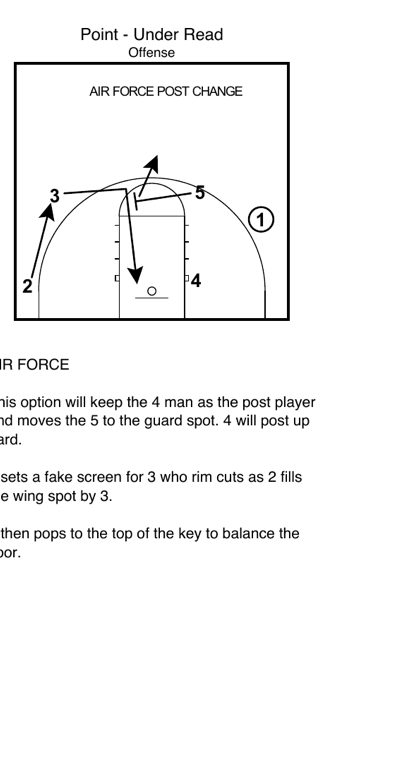
Air Force variation: 5 fakes the screen, 3 cuts to rim, 5 pops to the top.
The Point Under is not the right call if your point guard has no finishing ability at the rim — the rim cut must be a genuine threat. If 1 cannot score on a straight-line cut to the basket, the defense has no reason to account for it, and the whole action loses its edge. In that situation, the Point Over ball screen or the Point Away weakside action will produce better results.
How to Practice the Point Under
The most important thing to drill in the Point Under is the cut itself — specifically the timing between 1's entry pass to 5 and the sprint to the rim. Players who hesitate on that cut, or who wait to see if 5 looks at them, will never get the layup. The cut must be immediate, hard, and committed.
Phase 1 — Entry Pass and Rim Cut (1 and 5)
Start with just 1 and 5. 1 makes the entry pass to 5 at the high post and sprints baseline immediately. 5 catches and looks for 1 at the rim. Run this until the timing is automatic — the look from 5 must happen within one second of catching the ball. If 5 takes longer than that, the cut window has closed and the defense has recovered. Repetition at this stage builds the muscle memory that makes the rim cut a real scoring option under game pressure.
Phase 2 — Add the Screen and Post-Up (1, 4, 5)
Add 4 to the drill. Now 1 runs the baseline cut, 5 looks for 1, and if there is no pass, 4 steps up to screen for 1 turning out to the wing. After the screen, 4 posts up hard. Practice the feed from 5 (hi/low) and from 1 on the wing to 4 posting. Build the understanding that 4's screen is not a parking move — it is a screen followed immediately by a scoring action.
Phase 3 — Ball Reversal and Pin-Down (Full 5-Man)
Run the full action. 1 makes the entry, cuts baseline, uses 4's screen, receives on the wing. Then work the ball reversal: 1 to 2 to 4, with 5 setting the pin-down for 4 on the weakside. Require 4 to come off the screen with a shot-ready mindset — feet set, ready to catch and shoot. If 4 drifts out of position or catches flat-footed, the shot opportunity disappears.
Phase 4 — Live Defense with Read Progression
Add defenders and run the full action against live resistance. Require 1 to make a verbal call at each read point: "rim" if the cut is open, "post" if 4 is getting the entry, "reversal" if the ball goes to the other side. Verbal reads speed up decision-making and tell you as a coach exactly where players are in the read progression. If 1 is saying "reversal" before checking the rim cut, you know the first option is not being processed.
The complete breakdown drills for the Point Series — including the Under Read, the rim cut timing reps, and the pin-down shooting sequences — are in the full Princeton Offense system. Every drill is built to transfer directly to game action, not just produce clean-looking practice reps.
Point Under in the Larger Point Series
The Point Under is the third read in the OUA sequence — Over, Under, Away — that makes the Point Set a complete offensive package. These three reads look identical at the point of the high post entry. The defense cannot tell which read is coming until 1 either pops out (Over), cuts baseline (Under), or the ball is reversed to the away side (Away). That ambiguity is the whole point.
When defenses scout the Point Series, they focus on the Over Read because the ball screen is the most visible action. Shutting down the ball screen becomes a priority. That priority is what makes the Under Read available — a defense loading up to stop the ball screen has committed resources to a spot that the Under Read does not need. The 1 cuts the other direction, and the defense is wrong.
The Under Read also connects naturally to the Chin Set principles. The baseline cut from 1 is essentially a Chin backdoor cut applied within the Point Series context — the same instinct to cut when the defense overplays, the same sprint to the rim, the same look from the passer. Players who have learned the Chin Set read this action quickly because the habit is already built.
Beyond the OUA sequence, the Under Read feeds into the Air Force post change variation, which extends the action and shifts post responsibilities between 4 and 5. The pivot change and post swap built into that variation give you an entire secondary set of options once the initial Under action has been run. That depth is what makes the Princeton Offense a system and not just a collection of plays — every read has a counter, and every counter flows naturally out of the same alignment.
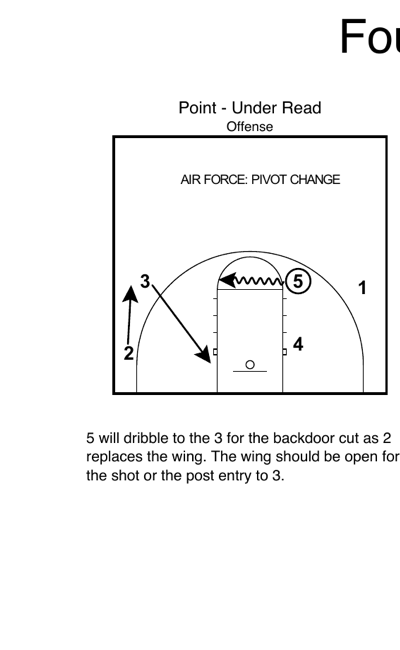
Pivot change: 5 dribbles toward 3, triggering the backdoor cut.
If you are installing the Princeton Offense actions in sequence, the order is deliberate. Start with the Chin Set to build the backdoor instinct. Add the Point Set and learn the Away Read first. Then the Over Read. The Under Read comes last because it builds on habits from both the Chin Set and the earlier Point Set reads. By the time your players are running the Under, they already understand the why behind every part of the action.
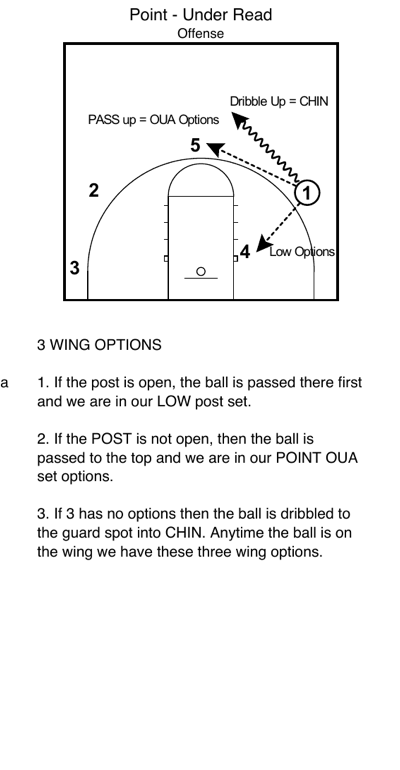
Wing options reset: dribble up to CHIN if no scoring read is available.
Get the Complete Princeton Offense System
Six sets. Fourteen counters. 42 breakdown drills. The full Point Series — every read, every counter, every diagram — including the Under Read, the Air Force variation, and all the ball reversal sequences. Plus five more sets from Coach Lee DeForest. 25 years of coaching distilled into one system.
Get the System — $39