The Twirl Series in the Princeton Offense
8 min read
What Is the Twirl Series?
The Twirl Series is a motion-style action within the Princeton Offense that creates scoring opportunities through guard circulation, down screens, and backdoor reads. Unlike the structured set plays of the Chin Set or the post-oriented Low Set, the Twirl Series has a fluid, free-flowing quality that makes it one of the hardest actions to scout and defend.
What makes the Twirl unique is the "circle" action at its core. Two guards cut through the paint and circle back to their starting positions off down screens set by the wing players. This looping movement creates constant motion, forces defensive rotations, and opens up backdoor cuts, post feeds, and perimeter shots on every repetition.
The Twirl Series includes three variations: the base Twirl (Circle), Twirl Over, and Twirl Reverse. Each one starts from the same initial entry but attacks the defense from a different angle. Together, they give your team a motion-based weapon that layers seamlessly onto the rest of the Princeton Offense action system.
The Base Twirl: Circle Action
The base Twirl action begins in a 1-2-2 alignment with your point guard (1) at the top, two guards (1 and 2) in the guard spots, two wings (3 and 4), and a center (5) at the high post. The entry is simple: the ball goes from a guard to the wing, and the motion begins.
Guard-to-Wing Entry
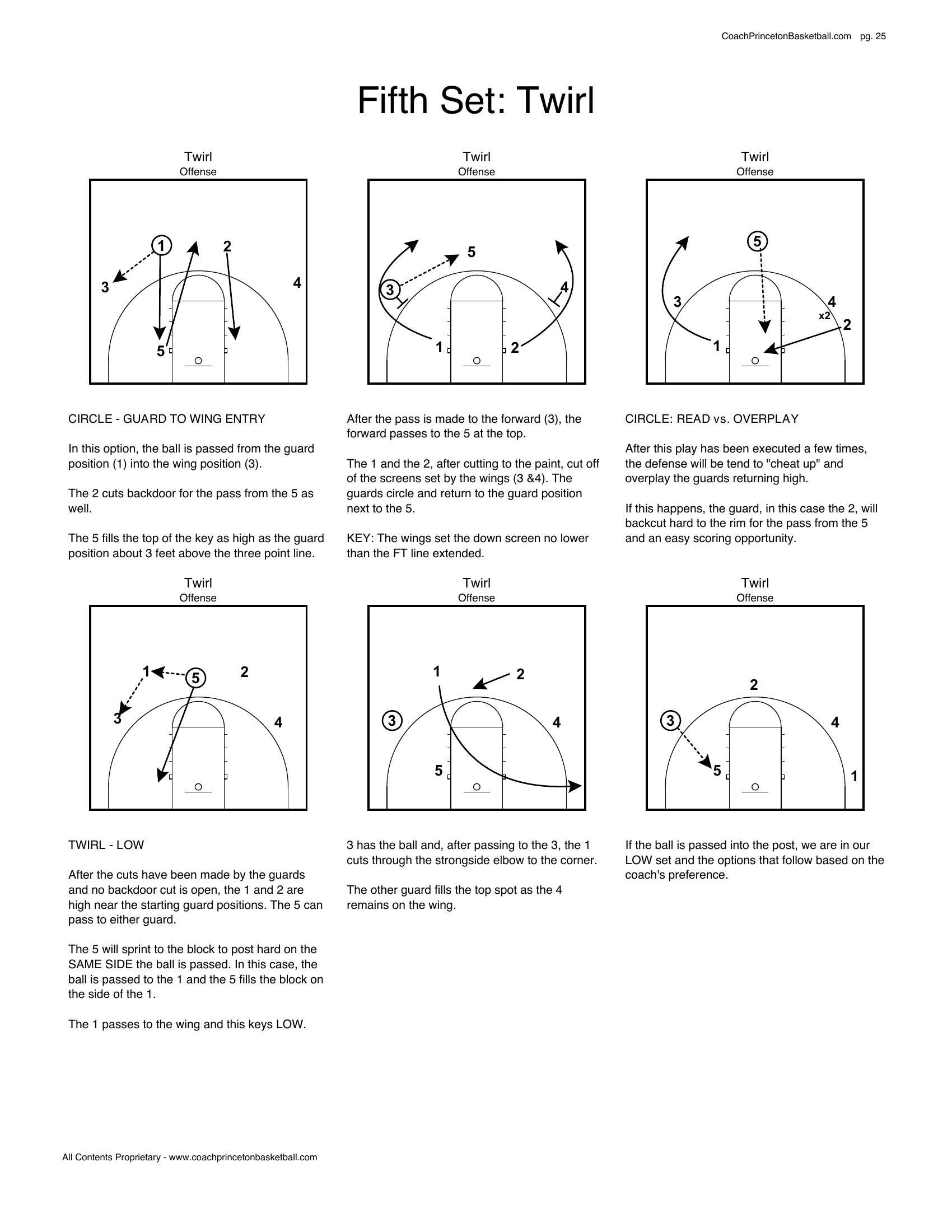
The ball is passed from the guard position (1) into the wing position (3). On that pass, two things happen simultaneously:
- The 2 cuts backdoor looking for a pass from the 5 for a layup. This immediate backdoor threat keeps the defense honest from the very first pass.
- The 5 fills the top of the key — moving up to the guard position, about three feet above the three-point line. The 5 is now the hub of the action at the top.
The Circle Cut
After the initial entry, the forward (3) passes to the 5 at the top. Now the signature action begins:
- The 1 and 2 cut to the paint and then circle back out to the guard positions, using down screens set by the wing players (3 and 4).
- The wings set the down screens no lower than the free-throw line extended. This is a critical teaching point — if the screens are too low, the timing breaks down and the guards arrive late.
- The guards return to the guard position next to the 5, who now has multiple passing options.
The 5 reads the defense and makes a decision: pass to either guard coming off the screens, look for a backdoor cut, or reset the action.
Reading the Overplay
After this circle action has been executed a few times, the defense will start to cheat up and overplay the guards returning to the top. This is exactly what you want.
When the defense overplays, the guard — in this case the 2 — backcuts hard to the rim for the pass from the 5 and an easy scoring opportunity. The backdoor is always the pressure valve in the Princeton Offense, and the Twirl's repetitive motion makes defenders increasingly vulnerable to it.
Twirl to Low
If the circle cuts produce no backdoor opportunity, the offense flows naturally into the Low Set. Here is how:
- The 5 passes to either guard (in this case the 1) and sprints to the block on the same side the ball is passed.
- The 1 passes to the wing (3), then cuts through the strongside elbow to the corner.
- The other guard fills the top and the 4 remains on the opposite wing.
- If the ball goes into the post, you are now in the Low Set with all of its post-up options available.
This transition from Twirl to Low is seamless. Your players do not need to call a new play or reset. The offense simply flows from one action into the next based on what the defense gives you.
Wing Dribble Up into Chin
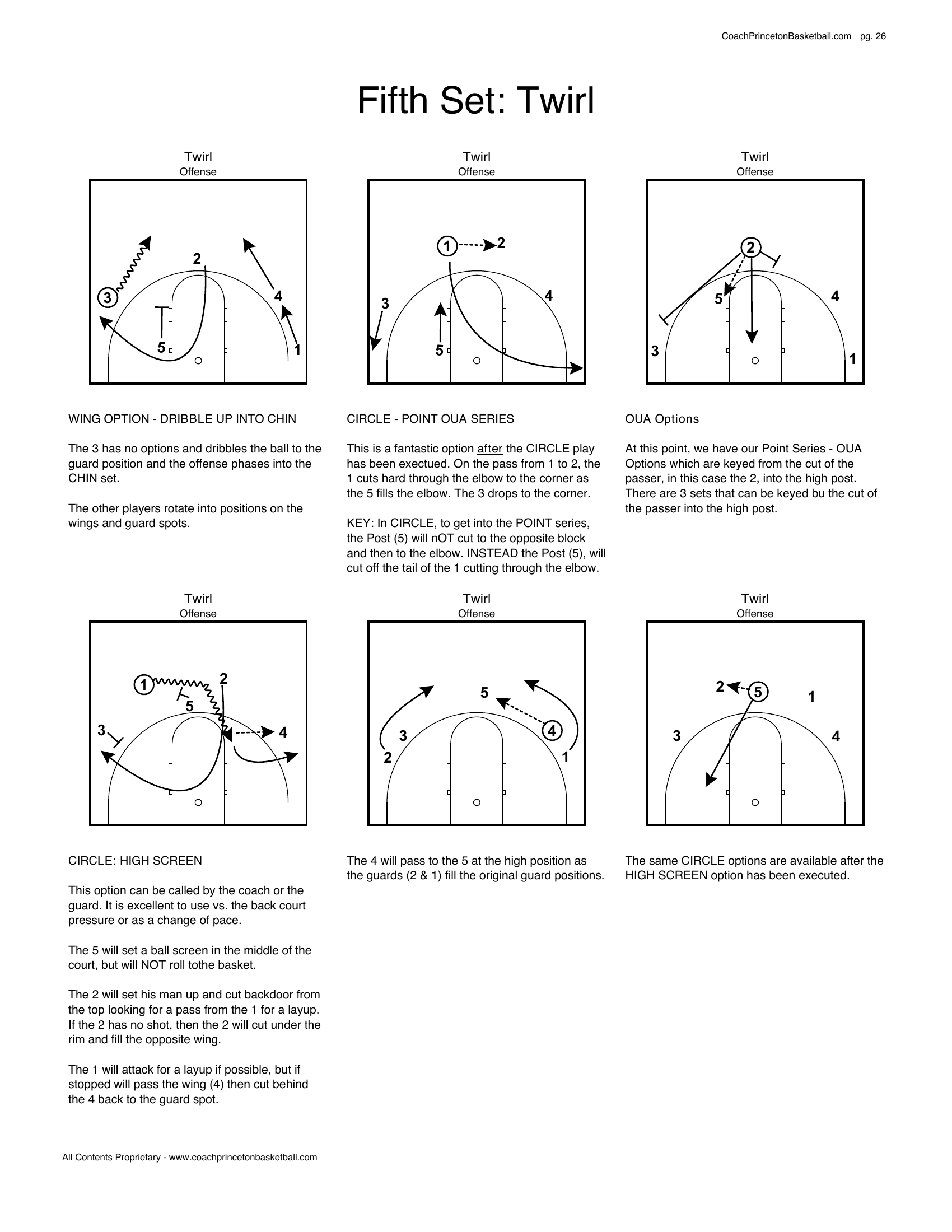
If the wing (3) has no passing options after receiving the ball, the offense has another natural exit: dribble up into the Chin Set. The 3 dribbles the ball to the guard position, and the other players rotate into Chin alignment on the wings and guard spots. From there, the full Chin Set continuity is available.
Circle into Point OUA Series
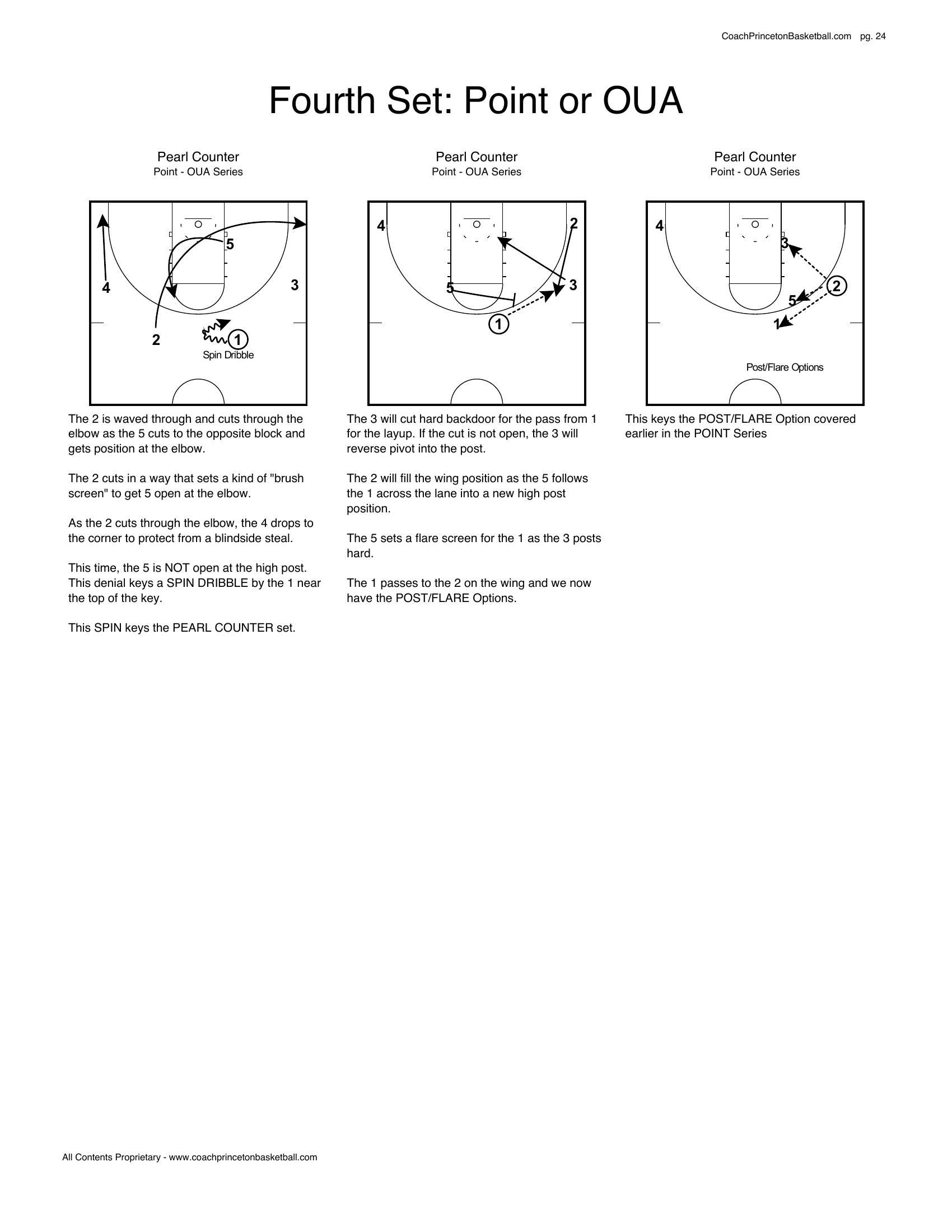
The Twirl can also transition directly into the Point OUA Series. On the pass from 1 to 2, the 1 cuts hard through the elbow to the corner as the 5 fills the elbow position. The key difference here: the 5 does not cut to the opposite block first. Instead, the 5 cuts off the tail of the 1 going through the elbow.
This puts you into the Point Series OUA options — Over, Under, and Away — which are keyed by the cut of the passer into the high post. Three different sets can be triggered from this single guard-to-guard pass.
Circle: High Screen Option
This option can be called by the coach or the guard as a change of pace, and it is excellent against backcourt pressure:
- The 5 sets a ball screen in the middle of the court but does not roll to the basket.
- The 2 sets up the defender and cuts backdoor from the top, looking for a pass from the 1 for a layup. If the backdoor is not open, the 2 cuts under the rim and fills the opposite wing.
- The 1 attacks off the screen looking for a layup. If stopped, the 1 passes to the wing (4) and cuts behind the 4 back to the guard spot.
- The 4 passes to the 5 at the high position, and the guards fill the original guard positions.
After the high screen, all of the same Circle options are available again. The defense has to defend the ball screen and the backdoor simultaneously — a difficult combination.
Twirl Over
The Twirl Over is a quick-hitter variation that uses the same Twirl entry but creates immediate scoring chances through a cross-screen and backdoor sequence.
How Twirl Over Works
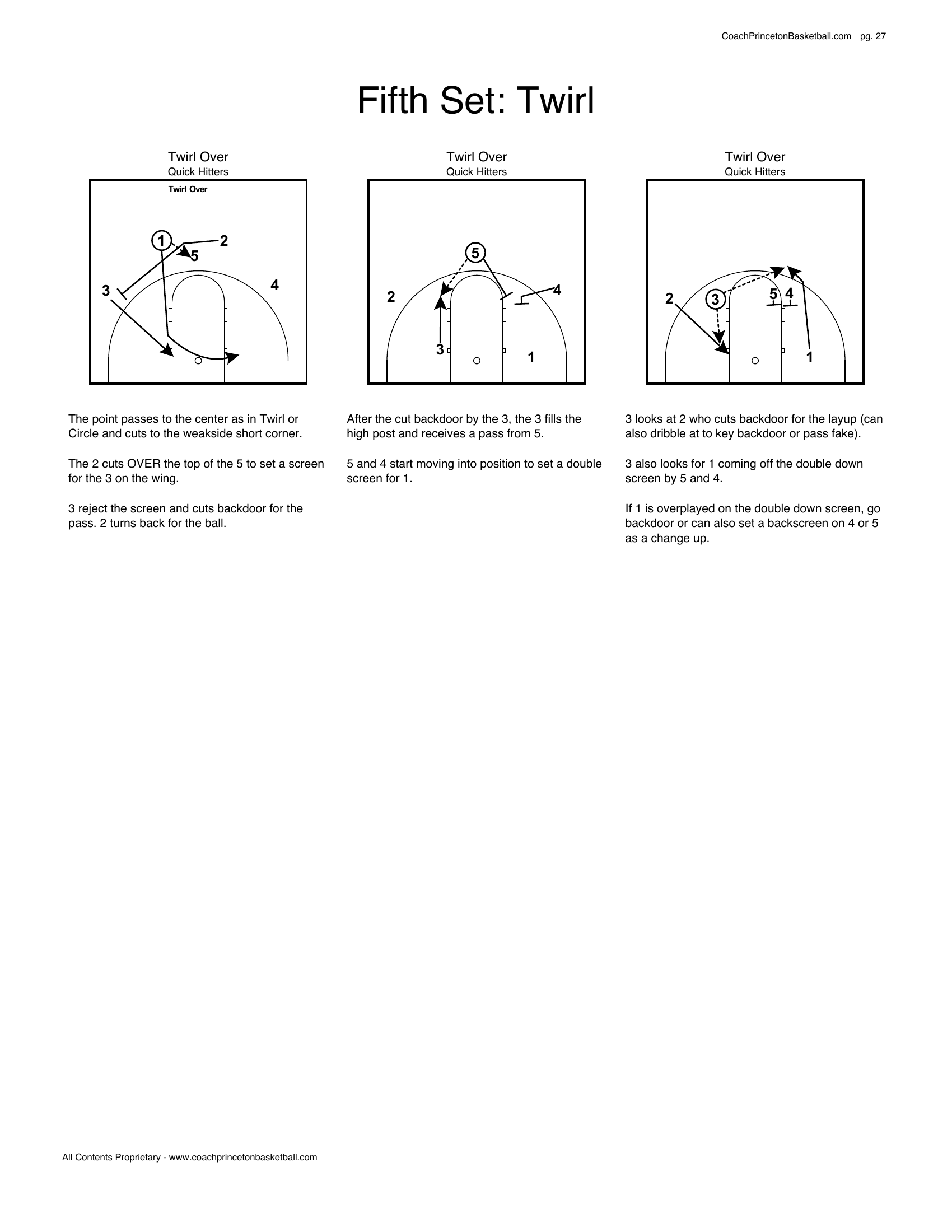
- The point guard (1) passes to the center (5) at the top, just like in the base Twirl, and cuts to the weakside short corner.
- The 2 cuts over the top of the 5 to set a screen for the 3 on the wing. This "over" cut is where the name comes from.
- The 3 rejects the screen and cuts backdoor for the pass. If the backdoor is open, it is a layup. If not, the 2 turns back for the ball.
Secondary Actions
If the initial backdoor cut by the 3 is not open, the play continues:
- The 3 fills the high post and receives a pass from the 5.
- The 5 and 4 set a double screen on the weakside for the 1 to come off.
- The 3 looks at the 2 cutting backdoor for the layup. The 3 can also dribble at the 2 to key the backdoor or use a pass fake.
- The 3 also looks for the 1 coming off the double down screen by the 5 and 4 for a perimeter shot.
If the 1 is overplayed on the double down screen, the 1 goes backdoor. The 1 can also set a back screen on the 4 or 5 as a change-up. Every overplay by the defense creates a backdoor opportunity — that is the Princeton Offense at its best.
Twirl Reverse
The Twirl Reverse is the third variation. It uses the same entry as Twirl Over but reverses the ball through a dribble handoff sequence to attack from the opposite side of the floor.
How Twirl Reverse Works
- The point guard (1) passes to the center (5) and cuts to the short corner — the same entry as Twirl Over.
- The 2 cuts over the top of the 5 for a dribble handoff from the 5.
- The 3 takes a dribble handoff from the 2, reversing the ball to the opposite side.
Scoring Opportunities
While this handoff sequence happens on the strong side, the weak side is loaded with action:
- The 5 and 4 set a double down screen on the weakside for the 1.
- The 1 cuts hard off the double screen for the shot. This is the primary scoring option — a clean look off two screens.
When the 1 receives the pass, the 3 cuts hard to the rim for a pass and possible layup. The 2 replaces at the guard spot. If no shot is available, the 1 dribbles to the top of the guard position as all players fill into Chin Set spots — and the offense continues.
Coaching Points for the Twirl Series
- Screen placement matters. In the base Twirl, the wing down screens must be set no lower than the free-throw line extended. Too low, and the timing of the guard cuts breaks down completely.
- Read the defender, not the play. The Twirl rewards players who read their own defender. If the defender overplays the circle cut, backcut. If the defender trails over the screen, curl. If the defender goes under, pop for the shot. The play does not dictate the action — the defense does.
- The 5 is the decision maker. In the base Twirl, the center at the top of the key controls the offense. The 5 must see the floor, read the overplays, and deliver the ball to the open man. Spend extra time with your post player on passing from the high post.
- Patience builds backdoors. The Twirl's circle action is designed to be repeated. Run it two or three times, and the defense starts cheating. That is when the backdoor cuts open up for layups.
- Exits must be automatic. Your players need to recognize when the Twirl flows into Low, into Chin, or into the Point Series. These transitions should not require a play call — the reads tell the players where to go.
When to Use Each Variation
- Base Twirl (Circle): Use as your primary motion action when you want continuous ball movement and guard circulation. Best against man-to-man defenses that switch or overplay on the perimeter.
- Twirl Over: Call this as a quick hitter when you need a backdoor layup or a clean shot off a double screen. Effective when the defense is aggressive on the wing and vulnerable to the reject-and-cut.
- Twirl Reverse: Use to reverse the floor and attack the weakside. Excellent against defenses that load up on the strong side or have weak help-side awareness.
- High Screen Option: Deploy against backcourt pressure or as a change of pace when the defense has adjusted to the standard circle cuts.
The Twirl is where the Princeton Offense starts to feel like a motion offense. The guards are circling, the ball is moving, and the defense is reacting instead of dictating. Once your team can run the Twirl and read the backdoor, you have a weapon that never runs out of options.
— Coach Lee DeForest
Practice Drills for the Twirl Series
Build the Twirl Series into your practice with these progressions. For more drill ideas, see the full Princeton Offense Drill Library.
Drill 1: Circle Cut Timing (5 minutes)
Run the base Twirl circle action at half speed with no defense. Focus on screen placement (free-throw line extended), guard cut timing, and the 5's passing reads. Repeat until the timing is automatic.
Drill 2: Backdoor Read (5 minutes)
Add a defender on one of the guards returning off the down screen. The defender overplays on the coach's signal. The guard must read the overplay and backcut for the pass from the 5. Alternate which guard gets the overplay.
Drill 3: Twirl to Low Transition (5 minutes)
Run the full circle action, then have the 5 pass to a guard and sprint to the block. The guard passes to the wing and cuts to the corner. Play live from the Low Set entry. This teaches the seamless transition from Twirl into Low.
Drill 4: Twirl Over and Reverse (10 minutes)
Walk through Twirl Over and Twirl Reverse at half speed, then increase to game speed. Emphasize the reject cut by the 3 in Twirl Over and the double-screen timing in Twirl Reverse. Add defenders progressively.
Frequently Asked Questions
What is the Twirl Series in the Princeton Offense?
The Twirl Series is a motion-style action within the Princeton Offense built around a "circle" cut — guards cut through the paint and circle back to the top off down screens set by the wings. It includes three variations: the base Twirl (Circle), Twirl Over, and Twirl Reverse, each creating backdoor cuts, post feeds, and perimeter scoring opportunities.
How does the Twirl Series differ from other Princeton Offense actions?
Unlike structured sets like the Chin Set or the post-oriented Low Set, the Twirl has a continuous, looping quality. The guards circulate through the paint and back to the top repeatedly, creating a motion-offense feel that makes it difficult for defenses to scout specific actions. It also transitions seamlessly into the Low Set, Chin Set, and Point Series.
Can the Twirl Series work against zone defenses?
The Twirl is primarily designed for man-to-man defense, where the circle cuts and backdoor reads exploit individual defensive overplays. Against a zone, the Twirl Over and Twirl Reverse quick-hitter variations can be effective because they create specific overloads and backdoor opportunities. However, the base Twirl circle action is best suited for man-to-man situations.
What skill level do players need to run the Twirl Series?
The base Twirl requires players who can set proper screens, read their defenders, and make accurate passes from the high post. It is more advanced than the Chin Set entry and is typically introduced after your team has mastered the Chin reads. The Five Out alignment can be a good intermediate step before adding the Twirl.
Get the Complete Princeton Offense System
Six sets. Fourteen counters. 42 breakdown drills. The complete system with all diagrams, reads, and counters. From Coach Lee DeForest, with 25 years of coaching experience.
Get the System — $39