Point Over: The Princeton Offense Over Read
8 min read
What Is the Point Over Read?
The Point Over is one of the core reads within the Point Set of the Princeton Offense. It is also called the Over Read because your point guard is attacking over the top of a ball screen set by the five — not splitting it, not rejecting it. Over the top, downhill, with two secondary options trailing behind.
This is not a freelance action. Every player has a defined job, a defined read, and a sequence of responsibilities that unfold based on what the defense does. Run it right and you are getting a layup from the one, a roll catch from the five, or a kick-out three to the four at the top. If the defense traps, you have a high/low counter that leads directly to a five roll layup.
After 25 years of coaching, I can tell you this: the Point Over is one of the cleanest ball screen actions in any offense. The reads are clear, the spacing is built into the alignment, and the trap counter practically runs itself if your players understand the principle behind it. Let me walk you through it.
Setup and Alignment
The Point Over grows out of the high post entry that starts the Point Set. Before the Over Read begins, here is where your players need to be:
- 1 (Point Guard) — up top with the ball, has just made the entry pass to the high post (5) and is now popping back out to receive the return pass.
- 5 (Center/High Post) — at or near the elbow, receives the initial entry and returns the pass to 1. Then sets a ball screen for 1.
- 4 — has been cutting to the rim off the initial high post entry action and finishing that cut through the lane.
- 3 — on the weakside, positioned at or above the weakside elbow.
- 2 — on the wing, spacing the floor.
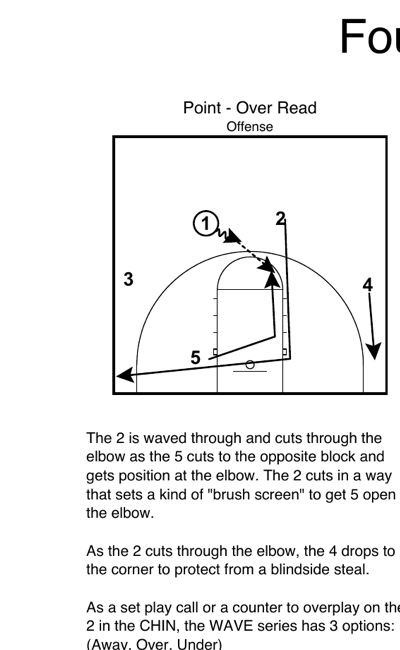
Initial setup — 1 at top, 5 at elbow, 2 waves through.
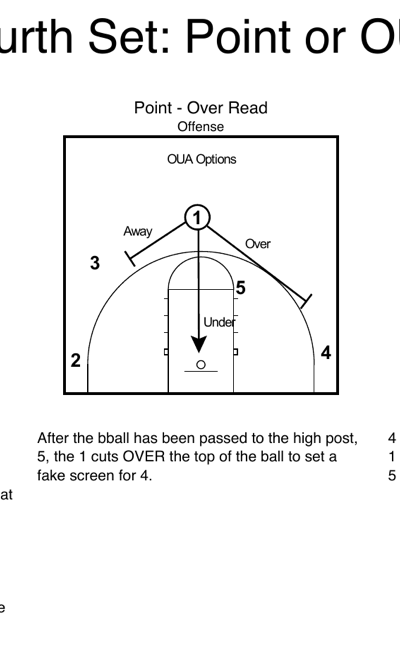
OUA options — overview of the three read options.
Key alignment rule: When 1 pops back out for the return pass from 5, the one must not be standing in the corner when they catch it. You want 1 above the break — high enough to use the ball screen from 5 and still have room to attack downhill. A corner catch kills the angle for the Over Read entirely.
There is also a built-in backdoor safety valve at this stage. If the defense is denying 1 on the pop-out, 1 does not fight through it — 1 simply cuts backdoor for the layup. The Princeton Offense never asks players to battle denial. Denial equals backdoor. That principle applies here just like it does everywhere else in the system.
The Read Progression — Step by Step
Once 1 catches the return pass from 5, here is the sequence:
Step 1 — 4 Finishes the Cut to the Rim
4 is already moving through the lane from the initial action. The cut does not stop just because 1 has the ball back. 4 finishes the cut all the way to the rim. This does two things: it keeps 4's defender occupied inside, and it sets up the next action — the down screen from 3.
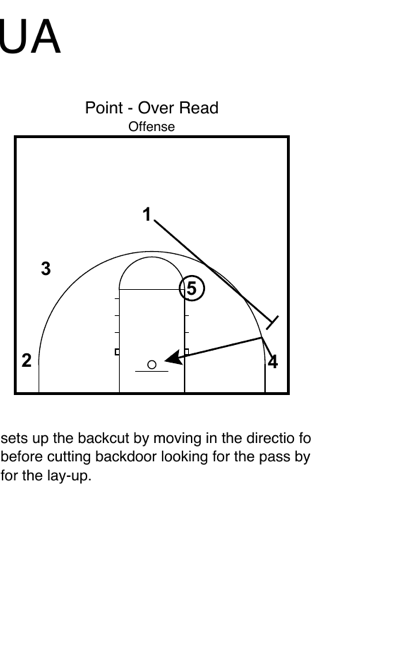
4 sets up backdoor, cuts to rim for pass from 5.
Step 2 — 3 Moves Above the Weakside Elbow
3 is doing two things simultaneously here, and this is the most important read in the whole action. 3 moves above the weakside elbow to set a screen for 4 cutting back to the top, AND to read how the defense is going to play the ball screen between 1 and 5.
This is not passive spacing. 3 is actively diagnosing the defense while moving into position. If the defense commits to trapping the ball screen, 3 needs to recognize it immediately and sprint to the top of the key. More on that in the trap counter section below.
Step 3 — 3 Sets a Down Screen for 4 Cutting to the Top
After 4 finishes the cut to the rim, 4 uses 3's down screen to cut back up to the top of the key. This is the third option in the read progression — not the first, not the second. But it is a real option, and the screen from 3 is what makes it available. 4 cuts off the screen looking for the kick-out pass from 1.
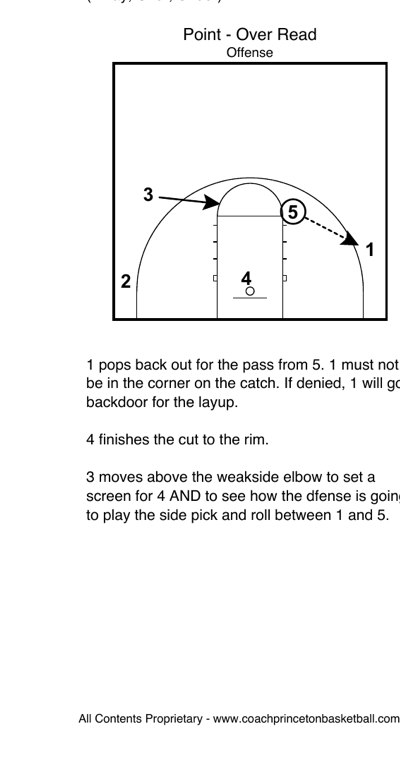
1 pops back out; 4 finishes cut to rim.
Step 4 — 1 Attacks Off the Ball Screen, 5 Rolls
This is the heart of the Point Over. 1 uses 5's ball screen and goes over the top — attacking downhill toward the basket. As 1 turns the corner, 5 rolls hard to the basket. 5 is not popping. 5 is rolling. The roll from 5 is the second option on this action.
1 makes this read in real time: Can I get to the rim? If yes, go. If the defense recovers and takes the layup, dump it to 5 rolling. If the defense collapses completely on both 1 and 5, kick it to 4 arriving at the top off the down screen from 3.
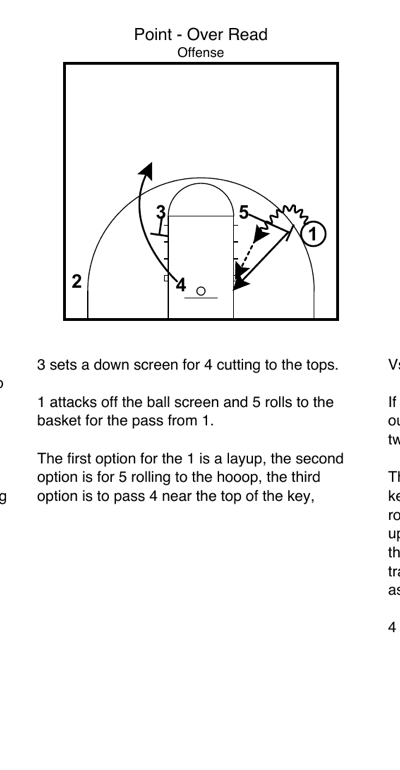
1 attacks off ball screen; 5 rolls to basket.
Ball Screen and Roll Action — The Three Options
The Point Over gives 1 three clear options coming off the ball screen. They are ranked in this order:
- First option: 1 layup. If 1 turns the corner and the lane is open, attack it. Do not hesitate, do not look for a secondary option. The purpose of the ball screen is to free 1 for this exact shot.
- Second option: 5 rolling to the hoop. If the defense shows hard on 1 or sends a second defender to cut off the drive, 5's roll is right there. The pass from 1 to 5 rolling is a short pocket pass — not a lob, not a skip. A direct pass to a player moving toward the basket.
- Third option: 4 at the top of the key. 4 has used 3's down screen and arrived near the top of the key. This is the safety valve. If both the lane and the roll pass are covered, 1 kicks it out to 4 for a shot or a reset.
Ball screen offense is not complicated. It is getting your point guard downhill, keeping the roll man honest, and having a third option so the defense cannot commit fully to the first two. The Point Over has all three. Run the read in order and you will find something every time.
— Coach Lee DeForest
What makes this action so effective is that the spacing is built into the alignment. 3 has cleared the weakside and is either screening for 4 or sprinting to the top depending on the defensive read. 2 is holding the wing. Nobody is cluttering 1's driving lane or 5's rolling lane. The court stays open because the roles are specific.
Counter vs. Trap Defense
Some defenses will try to trap the ball screen — sending two defenders at 1 as soon as 5 sets the screen. Against a standard coverage, the Point Over gets you a layup or a roll catch. Against a trap, you have a counter that is just as dangerous: the high/low attack.
Here is how it works:
1 strings out the trap. When two defenders jump the ball screen, 1 does not panic and does not give up the dribble. Instead, 1 dribbles higher — away from the trap, pulling both defenders away from the basket and toward the sideline. This is called stringing out the trap. Every step 1 takes away from the basket is another step those two defenders take away from protecting the lane.
3 sees the trap and sprints to the top. This is 3's read. If 3 has been watching the ball screen — which is exactly what 3 should be doing — 3 will see the trap develop in real time. The moment two defenders commit to 1, 3 sprints hard to the top of the key. This is not a casual cut. It is a sprint. The window between when 1 strings out the trap and when the defense rotates is short.
5 rolls to the basket. After setting the ball screen, 5 does not stand and watch. 5 rolls hard to the basket — the same roll as in the base action. The difference is that in the trap counter, 5 rolling is the scoring option, not just the secondary option.
The high/low finish. Once 3 catches the pass from 1 at the top of the key, the ball is immediately passed to 5 rolling for the layup. This is not a slow reversal. 3 catches and fires to 5 in one motion. The entire trap counter depends on 3 reading it early and 5 rolling on time. 4 clears out to the top to remove congestion from the lane.
This counter works because trapping a ball screen is a gamble. You are sending two defenders away from the basket hoping to force a turnover. The Point Over counter punishes that gamble directly — it uses the overcommitment against the defense by skipping the ball to a player in the exact spot the trap created.
For the high/low counter to work, two things must happen: 3 must cut for the ball up top (not wait to see what happens), and 1 must do a good job of pulling the trap by dribbling higher and forcing both defenders to follow. If either player hesitates, the window closes.
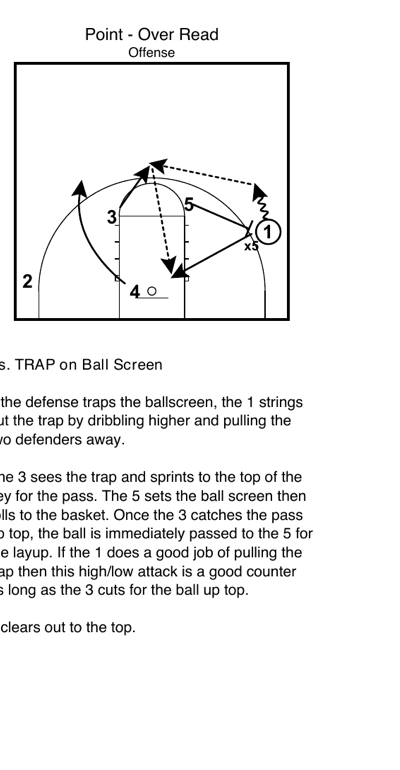
TRAP counter — 1 strings out trap, 3 sprints to top.
Air Force and High School Variations
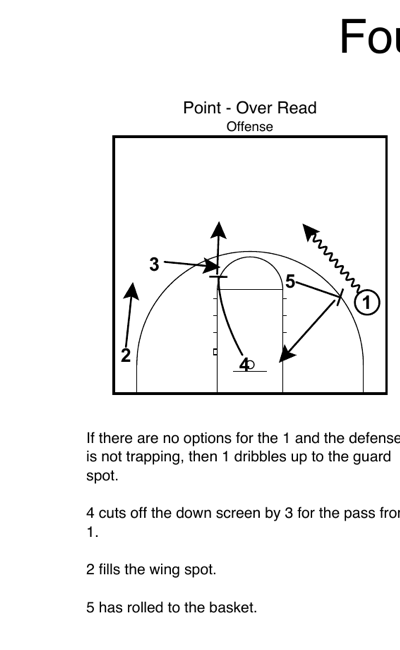
Air Force version — 1 dribbles up into ball screen.
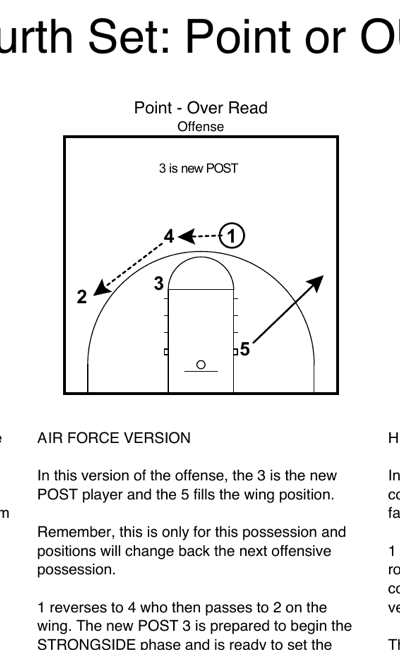
Air Force version continued — read progression off screen.
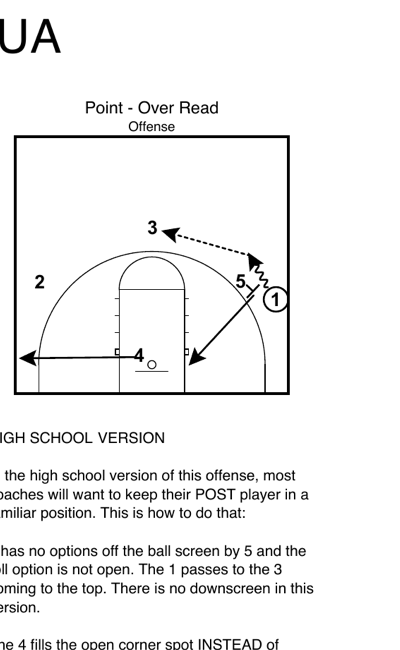
High school adaptation — simplified spacing, same reads.
When to Use Point Over
The Point Over is the right call when:
- Your point guard can turn the corner. The Over Read only works if 1 is a genuine threat to attack the basket off the ball screen. If the defense knows 1 will not shoot or drive, they will sag and take away the roll. Your 1 must be a real downhill threat.
- Your five rolls well. The second option on this action is a roll catch from 5. If 5 is a capable finisher at the rim — not necessarily a dunker, just someone who can catch a pocket pass and convert a layup in traffic — this action is dangerous. If 5 is slow to roll or not a reliable finisher, consider the Point Away instead, which gives you a different set of reads out of the Point Series.
- The defense is aggressive on ball screens. If a team is hedging hard or trapping your ball screens, the Point Over counter punishes them. Aggressive defenses create the exact spacing that makes the high/low attack work.
- You need a layup or foul. Late in a close game when you need a high-percentage shot, ball screen action to the rim is one of the most reliable ways to generate it. The Point Over gives your best ball-handler a clear downhill path with a roll option trailing behind.
The Point Over is not the right call if your point guard cannot threaten the basket, or if your five is not comfortable in ball screen-and-roll action. In those situations, the Chin Set backdoor action or a different read from the Point Series will serve you better.
How to Practice the Point Over
The most common mistake coaches make when installing this action is drilling the ball screen in isolation without training the 3's read. That produces players who know where to stand but not what to look for. Here is how to build the action correctly in practice:
Phase 1 — 3-Man Ball Screen and Roll (1, 4, 5)
Start with just 1, 4, and 5. 5 sets the ball screen, 1 goes over the top, 5 rolls, 4 arrives at the top off a simulated down screen. Work the three options in order: 1 layup, 5 roll, 4 kick-out. No defense yet. Build the reads through repetition before you add resistance.
Phase 2 — Add 3 and the Full Weakside
Bring in 3 and 2 and run the full action. Now 3 is physically setting the down screen for 4 and practicing the transition from screener to spacing. Players need to feel the timing of when 4 uses the screen relative to when 1 is attacking off the ball screen. These two actions happen simultaneously and must be coordinated.
Phase 3 — Add Defense and Call the Reads Out Loud
Add live defenders. Require 1 to call the option out loud after making the decision — "layup," "roll," or "four" — so you can hear whether the read matches the defensive coverage. Players learn faster when they verbalize decisions in real time. If 1 is calling "roll" when the lane was open, you know where the breakdown is.
Phase 4 — Trap Simulation
Run the trap counter specifically. Put two defenders on 1 at the point of the ball screen and require them to trap hard. 1 practices stringing out the trap, 3 practices sprinting to the top on the recognition read, and 5 practices the roll-and-finish. Do this until the read is automatic. The trap counter fails when 3 waits too long — drilling it removes the hesitation.
The full Princeton Offense system has specific breakdown drills for every set and every read. The Point Series drills are designed to build the ball screen reads from simple to complex, so by the time your players see live defense they already know what they are looking for. You can find those drills, along with the complete Princeton Offense counters, in the full playbook.
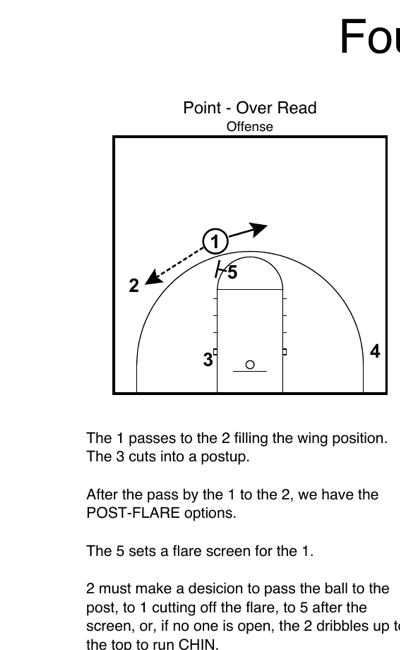
Post-flare option — 5 flares, ball kicks to 2 on wing.
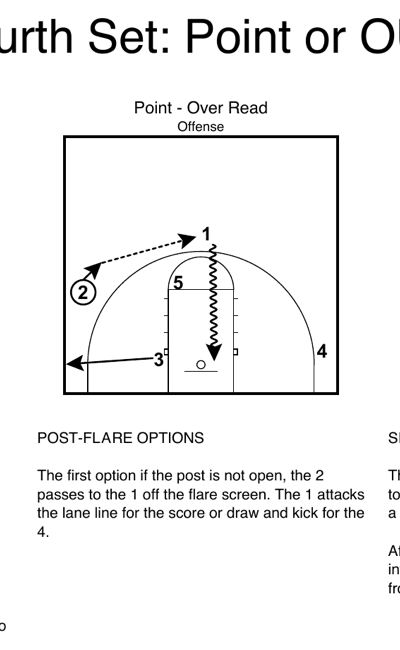
Post-flare continued — weakside post and secondary options.
Point Over in the Larger Point Series
The Point Over is one read within the Point Set — a broader package that puts your best ball-handler in control of the offense. The Point Set gives you multiple reads out of the same initial alignment, so the defense cannot key on one action. The Over Read is the ball screen read. The Away Read (covered in Point Away) gives you movement and screening actions on the weakside. Together, they make the point guard a threat in multiple directions out of the same look.
This is how the Princeton Offense works at every level. You learn the alignment once. Then you learn two or three reads out of that alignment. Then you learn the counters to each read. By the time you have installed the full system, your players understand principles — not just plays — and they can read the defense in real time rather than waiting to be told what to run.
If you are just getting started, begin with the Chin Set. It teaches the backdoor read and the continuity principles that carry through every other set. Once your players understand the Chin Set, the Point Series reads become much easier to install because the habits are already built in.
Get the Complete Princeton Offense System
Six sets. Fourteen counters. 42 breakdown drills. The full Point Series — including every read, every counter, and all the diagrams — plus five more sets from Coach Lee DeForest. 25 years of coaching distilled into one system.
Get the System — $39