Point Away: The Princeton Offense Away Read
8 min read
What Is the Point Away Read?
The Point Away is one of the three primary reads out of the Point Series in the Princeton Offense. Where the Point Set establishes the entry and the basic high-post game, the Away Read sends the point guard cutting in the opposite direction — away from the ball — to create a layered set of counters that are extremely difficult for man-to-man defenses to stop.
Over 25 years of coaching this offense, I've seen the Away Read produce more easy baskets than almost any other action we run. The reason is simple: the fake screen misdirects the defense, the flare screen removes the help defender from the lane, and the kick-out creates a clean three-point look on the weakside. That is three scoring options out of a single decision by your point guard.
If you want to run the full Point Series — Over, Away, Under — you need to be able to execute the Away Read cleanly. Defenses that see nothing but the straightforward entry get comfortable. The Away Read makes them pay for that comfort.
Setup and Alignment
The Point Away begins from the same initial alignment as all Point Series actions. Your personnel on the floor:
- 1 (Point Guard) — top of the key, initiating the entry
- 5 (High Post) — elbow or high post area, the initial pass target
- 3 (Wing) — strong-side wing
- 4 (Corner/Wing) — weak-side corner or wing
- 2 (Weak Side) — weak-side wing or corner
The spacing must be clean before the entry pass. If your players are bunched up, the reads collapse and the defense can help freely. Make sure your wings are wide and your corners are down. The high post should be at the elbow, not deep in the lane — the pass has to be crisp and catchable on the move.
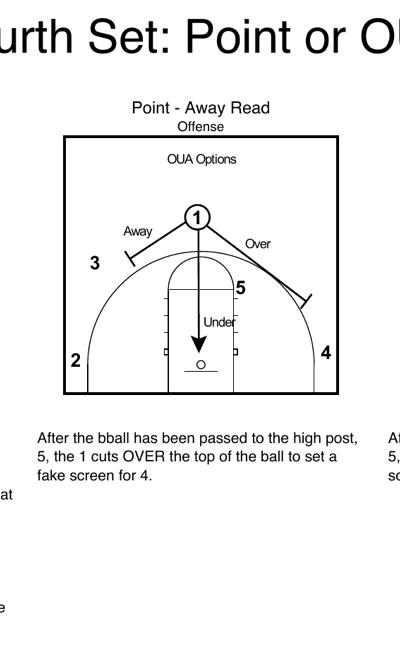
OUA read options — Away, Over, and Under from the point
The Read Progression
Here is the Point Away read broken down step by step. Each step builds on the one before it. Teach them in sequence and your players will start to see the floor open up as the action develops.
Step 1: Entry Pass to 5 at the High Post
The 1 passes to the 5 at the high post. This is the trigger for the entire action. The 5 must catch the ball in a strong position — feet set, ready to pass, read the defense, and make a decision.
The entry pass to 5 is not just a setup pass. If 5 has an immediate scoring opportunity off a flash or seal, take it. But the primary purpose here is to relocate the 1 and stress the defense.
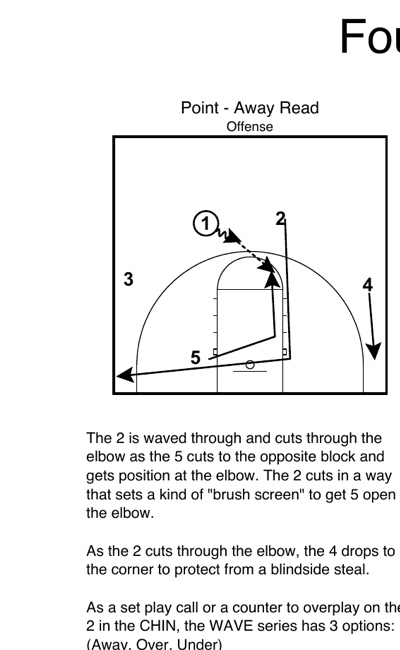
2 waves through elbow; 5 cuts to opposite block
Step 2: The 1 Cuts Away
After the entry pass, the 1 cuts AWAY from the ball — toward the weak side — to set a fake screen for the 3 (or for 4, depending on the alignment). This cut away from the ball is the defining action of this read.
The cut needs to look like a real screen. If the 1 strolls across and the defense reads it as a dummy cut, the action loses its effectiveness immediately. Sell the screen. Go at the defender. Make contact if necessary. The more convincing the fake, the more the defense has to account for it.
This is the hardest thing to teach. Most point guards want to stay on the ball side. You have to train them to cut with purpose when the ball goes away.
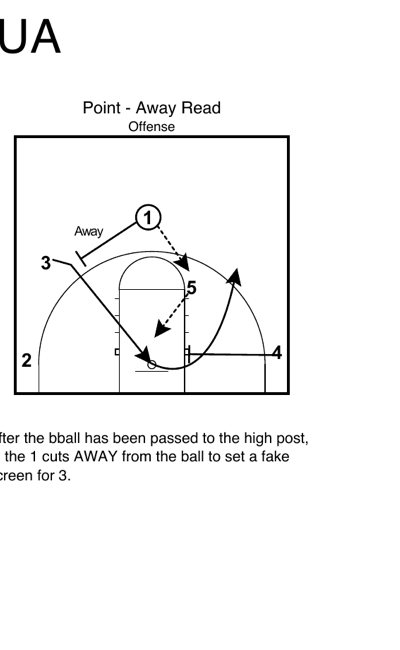
1 cuts away to set fake screen for 3 on the weak side
Step 3: 5 Passes Back to 1
After the fake screen action, the 5 passes back to the 1. The 1 should be emerging from the cut with some momentum, which makes the catch-and-drive option immediate.
The defense on X1 has just had to follow a cut across the top of the key and react to a fake screen. That defender is now behind or off-balance. The 1 receives the ball in space with a short recovery distance to the basket.
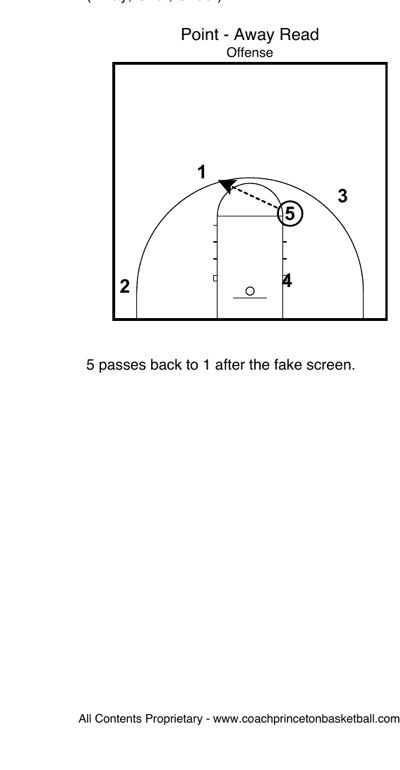
5 passes back to 1 after the fake screen action
Step 4: The Ball Screen Option
If the 1 chooses to use a ball screen rather than driving the lane directly, the 5 sets a ball screen at the top of the key. Here is the key coaching point that separates the Princeton Offense from a standard pick-and-roll: the 5 does NOT roll to the hoop.
Instead, the 5 follows the 1 across the top of the lane after setting the screen. This is called the "follow" action. It creates a very different look than what most defenses prepare for, because the roller — the big man — stays high and trails the guard instead of cutting to the basket.
If the elbow jump shot is available as the 1 comes off the ball screen, the 1 can take it. But the majority of the time this ball screen action is designed to generate the pass to 3 on the wing, not to produce a self-created shot. Teach your point guard to keep moving and look for the wing pass first.
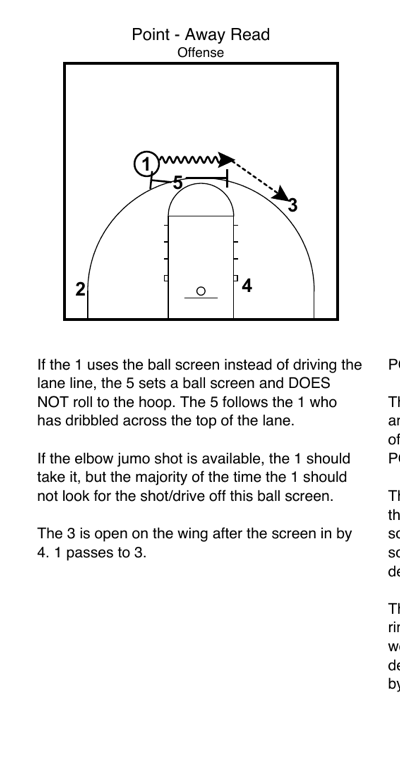
5 sets ball screen then follows — does not roll to the hoop
Step 5: Pass to 3 on the Wing
The 3 is open on the wing after the screen set by the 4. Once the 1 dribbles across the top of the lane and the defense is scrambling to recover from the ball screen, the 3 receives the pass on the wing.
This wing pass is not just a reset — it keys the Post and Flare options described in the next section. Teach your point guard to look for this pass aggressively. The 3 should be ready to catch, survey, and either shoot, enter the post, or trigger the flare action.
Post and Flare Options
The pass to 3 on the wing unlocks what the playbook calls the POST/FLARE Option — a layered set of actions that is common throughout the Princeton Offense and one of the most effective two-action combinations you can run against a switching or help-heavy defense.
The Flare Screen Option
After the 1 passes to 3, the 5 sets a flare screen on the defender guarding the 1 (X1). The 1 uses the flare screen to create an open catch on the weak side.
The action of a ball screen followed immediately by a flare screen is extremely hard for X1 to defend. They have just fought through or gone under a ball screen, and now they have to navigate a flare screen from the opposite direction.
When the 1 receives the ball off the flare, they attack the rim on the drive. The flare screen opens the lane on the weak side — the help defender on X2 often has to commit to stop the drive, leaving the 2 open in the corner for a three-point kick-out.
This is one of the cleanest three-point looks in the entire offense. The ball moves, the screen creates a lane, the help defender leaves, and the shooter is wide open in the corner.
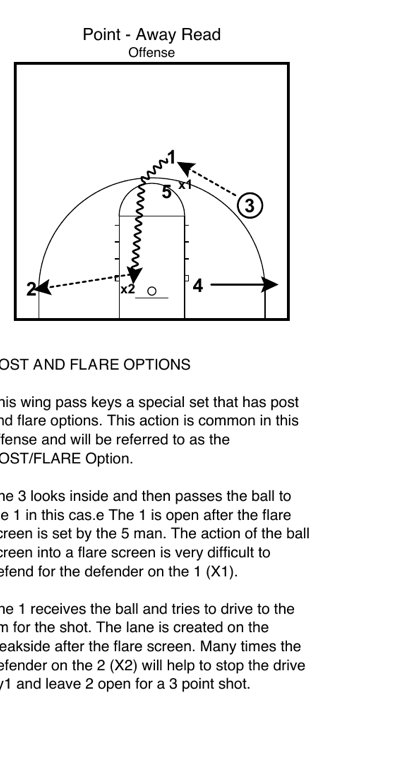
Post and flare options after 1 passes to 3 on the wing
The Post Entry Option
Instead of triggering the flare, the 3 can also look inside to enter the ball into the post. The 4 is frequently open after setting the screen — the defender on 4 is typically focused on the wing pass and not ready for a hard seal and post entry.
The 4 sets the screen for 3, and as the defense adjusts to the wing pass, the 4 seals hard and calls for the post entry from 3. The 4 looks to score first but should also check the cut of the 1 coming off the flare — if X1 pressures the 1 hard off the flare screen, the lane is open for a drop pass and layup to the cutting 1.
The second look from the post is the 1 spotting up at the top of the key for a three-pointer. When X1 sags into the lane to help on the post, the lane opens at the top. The 5 should recognize this and set a screen down on X1 to give the 1 a clean catch-and-shoot opportunity from above the break.
The Five Out Counter
When the 1 passes to 5 at the top of the key instead of taking the flare or wing options, the offense transitions into a Five Out alignment. The 4 can attack the middle with the dribble and locate the 2 in the corner against any remaining help coverage in the post.
This is the built-in answer to a defense that loads up on the flare or post actions. Once your players read it, the counter happens naturally without a timeout or new call.
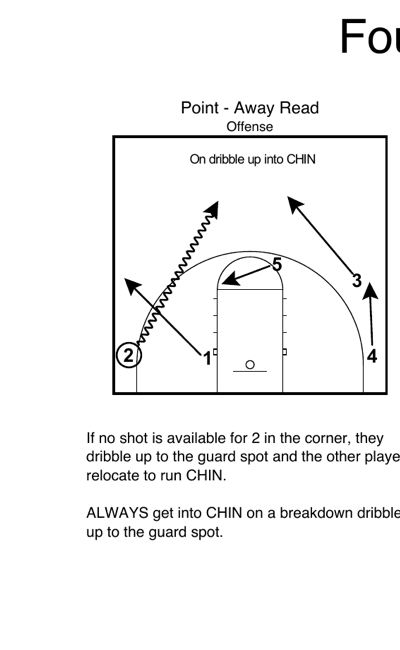
Dribble up to CHIN continuity when no shot is available
Counter vs. Trap
Aggressive defenses will try to trap the 1 as they receive the pass back from 5. This is a predictable overreaction and the Point Away is designed to punish it.
When the defense traps the 1 coming off the fake screen or ball screen:
- The 5 is open at the elbow. If X5 helps on the trap, the 5 flashes to the ball and receives the pass for the mid-range jumper or a skip to the opposite wing.
- The weakside wing is open. Trapping with two defenders means someone on the weak side is unguarded. Train your 1 to read pressure and skip the ball quickly before the rotation recovers.
- Drive the gap. Two defenders committing to a trap leaves a gap between them. A decisive first step through that gap gets the 1 to the rim before the rotation arrives.
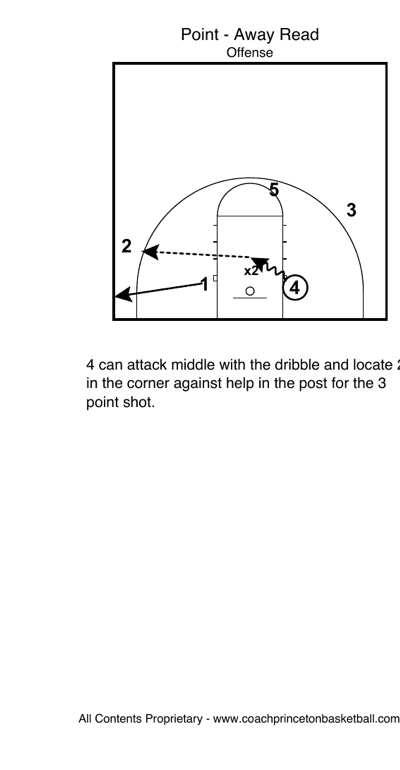
4 attacks middle on the dribble, finds 2 open in the corner
The Princeton Offense counters work best when your players understand the base action well enough that they recognize defensive overplays automatically. Do not add the trap counter until your team can run the base Away Read cleanly. Layering complexity on top of confusion produces nothing.
When to Use the Point Away
The Away Read works best in specific game situations. Here is when I call it:
- When the defense is overplaying the strong side. If X1 is cheating toward the ball, the cut away opens immediately and the fake screen becomes a legitimate scoring action.
- When you need a three-point shot. The flare screen kick-out to the corner is one of the most reliable three-point opportunities in the offense. Late in a quarter when you need points fast, this is a clean option.
- When the post is being denied. If the defense is loading up to deny direct post entries, the Point Away gets the ball into the post through the wing, which is a much harder pass to deny.
- As a change-up after running Point Set. If your opponent has scouted the Point Set entry and is jumping passing lanes, the Away Read sends the 1 in the opposite direction and catches them out of position.
- When your point guard needs to get easy touches. The fake screen and receive-back action puts the ball in the 1's hands in space with momentum. It is a low-risk way to get your best ball-handler attacking downhill.
How to Practice the Point Away
The biggest mistake coaches make is installing the Away Read as a standalone play. It is not. It is one read in a family of reads. Teach it in context with Point Set and Point Over so your players understand that they are making a read, not running a scripted action.
Here is the practice progression I use:
- 3-man walkthrough: 1, 5, and 3. Run the entry pass, the cut away, the receive-back, and the wing pass without defense. Get the footwork right. The 1's cut needs to be purposeful, and the 5's timing on the return pass matters.
- Add the ball screen follow. Once the basic cut is clean, add the ball screen by the 5 and the follow action across the top. Walk through the "follow, don't roll" concept until the 5 stops instinctively rolling to the rim.
- 5-man half-court with no defense. Add all five players and run through the full read progression, including the Post/Flare option after the wing pass. Call out reads verbally as they happen.
- 5-on-5 with a read defender. Put X1 on the 1 and let them play the cut. The 1 should make the read based on where X1 is positioned — if X1 plays over the fake screen, the 1 cuts away harder; if X1 drops, the 1 spots up for the receive-back jumper.
- Live 5-on-5. Run the full offense and let the Away Read emerge naturally when your 1 reads the right moment to call it. If you have to force it, the read is not there yet.
The Princeton Offense is not a system of plays — it is a system of reads. The Point Away is not something you call from the bench. Your point guard reads the defense, recognizes the opportunity, and executes. That is what separates this offense from a play-calling system.
— Coach Lee DeForest
One more thing to install in practice: the reset. When the Point Away does not produce a shot, your players need to know how to get back into Chin continuity. If no shot is available for the 2 in the corner, they dribble up to the guard spot and the other players relocate. Always get back into Chin on the breakdown. The offense never stops.
For a complete look at how the Point Series fits into the full system — including all six sets and fourteen counters — the full playbook has every diagram, coaching point, and drill progression you need.
Get the Complete Princeton Offense System
Six sets. Fourteen counters. 42 breakdown drills. The full Point Series — Set, Over, and Away — with all diagrams, reads, and counters. From Coach Lee DeForest, with 25 years of coaching experience.
Get the System — $39