Chin Diagram: Guard Entry and Backdoor
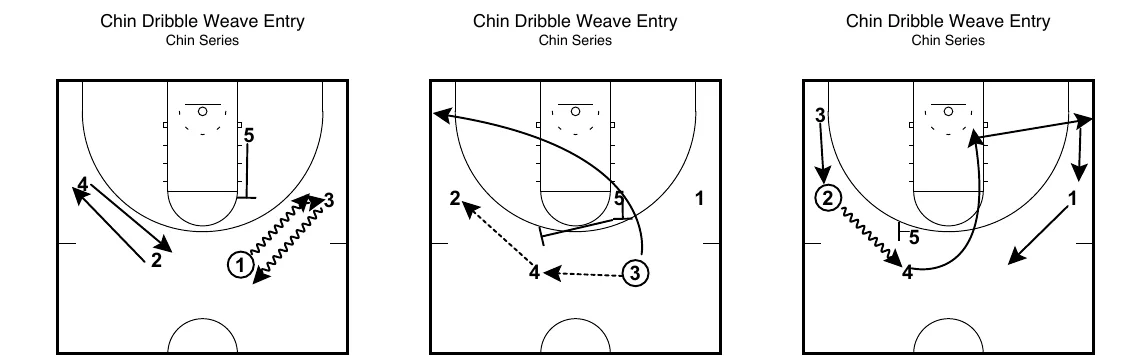
In Chin, 1 hands off to 3 and 2 exchanges with 4. 3 passes to 4, then 4 passes to 2 on the wing. As 4 releases that pass, 3 uses 5's backscreen. 5 immediately flare-screens for 4. The first diagram shows the entry, so follow the next frames for the screens.
Point Diagram: Over, Under, Away
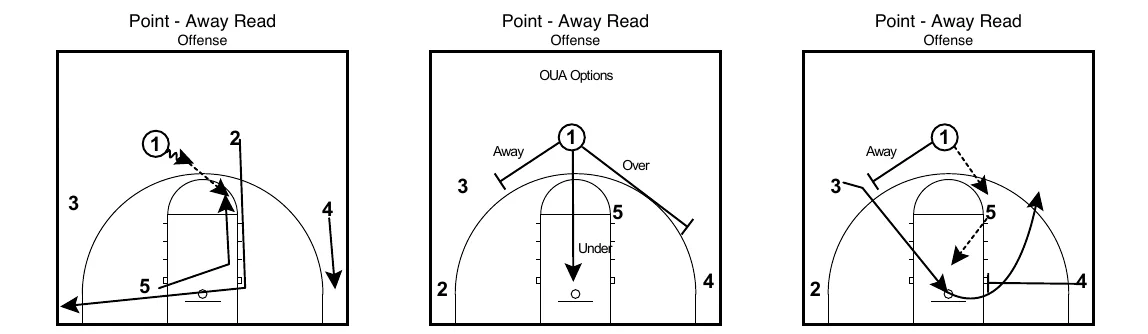
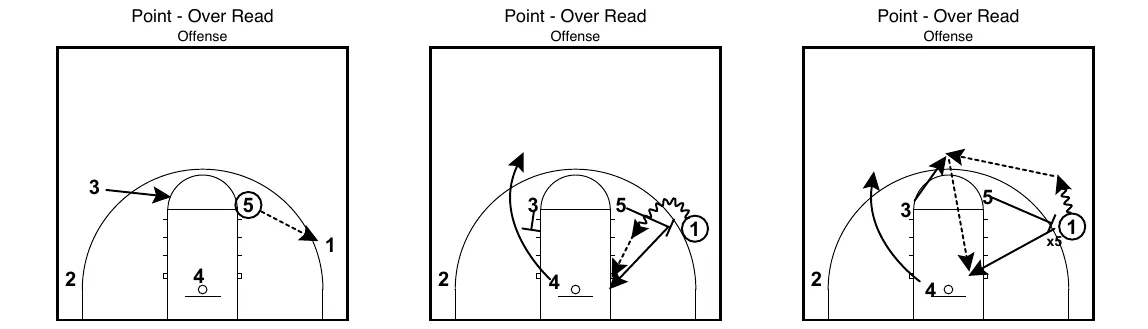
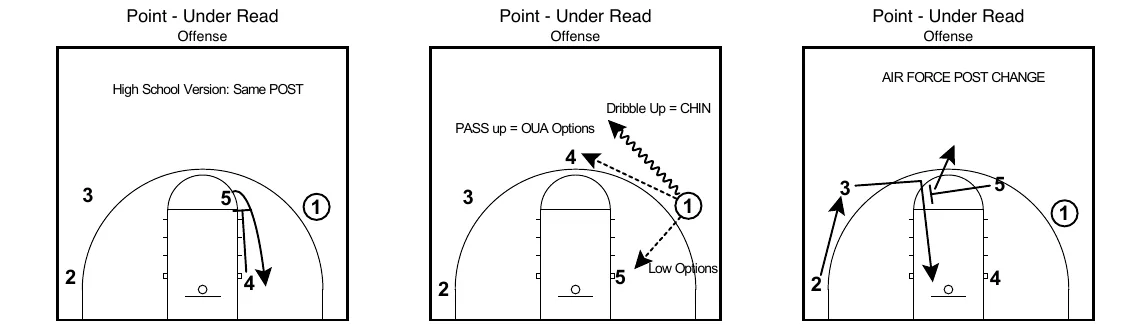
5 catches at the elbow. Over, Under, and Away name the passer's route while 5 holds the ball. In Over, the passer moves over 5 toward 4. In Away, the passer moves away toward 3. Under sends the passer to the rim. Read each row in order before adding its return pass or ball screen.
Low Diagram: Post Entry Angles
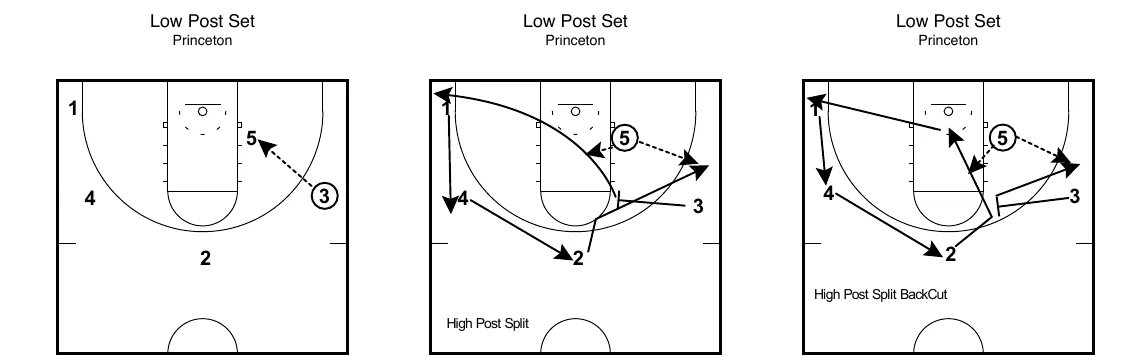
Low begins when the ball enters the low post. 5 can score while the perimeter players run the chosen split, curl, or Laker cut. If those options are covered, 5 passes back out before the wing chooses a pass up to Point or a dribble up to Chin.
Twirl Diagram: Continuous Rotation
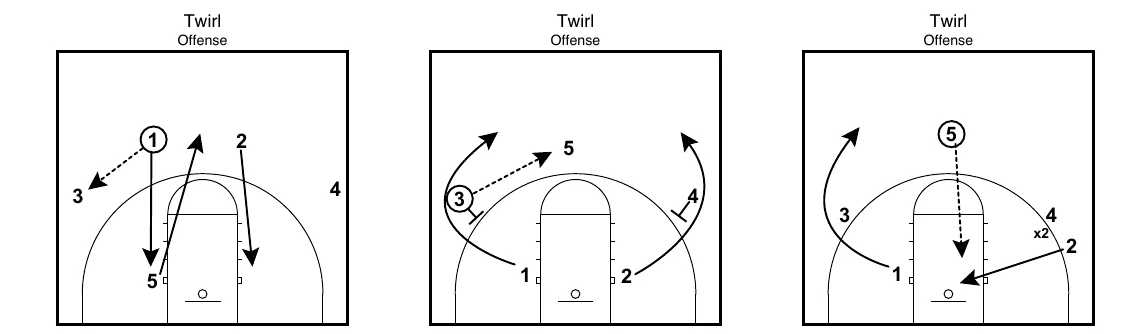
Twirl begins with 1 passing to wing 3, then 3 passing to 5 at the top. The guards cut through and return high off the wings' down screens. An overplayed guard can backcut. Follow the Twirl frames before adding its Low or Point continuation.
How to Teach Diagrams Without Freezing Players
Show the diagram, walk the first pass, then remove the paper. Players should learn the trigger and the read, not just the path on the page.
Using Diagrams With Players
Show one diagram, then immediately walk it on the floor. Players should point to the defender they are reading before they move. This prevents the common problem where athletes memorize arrows but fail to recognize why the arrow exists. Diagrams are a starting point, not the lesson.
Diagram Progression
Start with the entry that fits the roster. If using Chin first, teach the weave, the 4-to-2 pass trigger, and the backscreen-to-flare sequence. Add its continuation before adding a separate Point, Low, or Twirl entry.
What to Add to Every Diagram
Mark the ball, numbered roles, pass order, screen direction, and next receiving spot. Add the defensive cue for each optional read. Some diagrams begin with a low-post catch or a perimeter exchange, so a high-post catch does not belong in every frame.
From Diagram to Live Play
After a diagram walk-through, use guided defense before going live. Tell the defender to deny once, trail once, and switch once. The offense must choose the correct answer. This bridge keeps the diagram from falling apart when the defense stops cooperating.
How to Use This Resource This Week
Pick one idea from this play diagrams resource and build it into your next practice plan. Start with a short walk-through, then add guided defense, then finish with a live segment where the defense is allowed to take away the first option. The Princeton Offense improves when players connect the concept to a defensive trigger, not when they simply memorize where to run.
For example, if the focus is spacing, freeze the possession whenever one defender can guard two players. If the focus is a backdoor read, give the defender permission to deny and require the passer to deliver the ball on time. If the focus is a counter, make the defense switch, help, or sit in a zone so the offense has to recognize the answer under pressure.
This page should work as a teaching layer, not a standalone system. Use it with the complete Princeton Offense guide, the installation plan, and the Princeton Offense PDF playbook so your team has the full progression: concept, drill, set, counter, and game application.
| Coach's checkpoint | What to look for |
|---|---|
| Spacing | One defender should not be able to guard two offensive players. |
| Timing | Cuts and passes should happen as the defender commits, not after the window closes. |
| Decision | Players should be able to name the defensive trigger that created the read. |
Need the complete Princeton Offense package?
The Princeton package includes the playbook with six sets, original diagrams, set plays and counters, plus the video walkthrough and Practice Plans & Drills Guide.
Download the Playbook - $39